
Activism
Last week, we wrote about the growing number of event-driven opportunities we are seeing in the market.
We have tracked activists’ campaigns since inception, and we have seen some real weird stuff. My personal favorite: Lifeway issues a press release stating that the activist (the CEO’s brother) cannot be appointed to the BoD because there’s a restraining order against the CEO.
It’s like reality TV, but with worse-looking people.
Activism drives change, which in turn creates investment opportunities. But they require a deep understanding of the situation. That’s what we try to track for you. In the case of Lifeway, the company became investable (and was flagged by KEDM) when the activists threw in the towel and left the CEO actually to run the company.
Let’s talk about activism in its most basic form. Call it activism 101.
In many cases, when a stock goes down, shareholders blame it on poor management execution rather than on their own decision to allocate to a dwindling business. (See our kliff note below on Dave & Buster’s, who just moved on their 4th CEO in 3 years.)
You write an angry letter to management to remind him who’s boss. Better get the share price up, or else! We recommend you do buybacks now, while you make a new investor deck that tells everyone how undervalued you are.
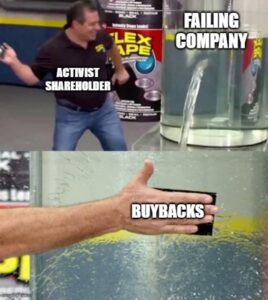
But in many cases, shareholder concerns are legit, and the playbook is more complicated. Activists can demand their own representation on the board, or simply an independent director. The thinking is that if the director did not smoke weed with the CEO at college, he is more likely to weigh the interests of minority shareholders and to disagree with the CEO as needed.
Activists can demand real strategic change. A disposal or separation of underperforming businesses. Or a change of management if they’re not the right person for the job.
And if all that fails, they can always demand a sale of the company…
The case for Costar Group
With that in mind, let’s talk about Costar Group.
We know Costar because our compounder bro friends have been talking about this company for years. It’s a founder-led success story that is best described as the Bloomberg of real estate.
Costar has the broadest dataset of commercial real estate transactions. If you want to deal in real estate and you don’t want to work blind, you’d better pay up for their data because there is no alternative.
Not unlike Bloomberg, they sacrifice a bit of customer goodwill each year by raising prices, which the market likes when it’s called organic growth. In addition, CSGP does a good job of launching new features and cross-selling them across their different platforms.
Early investors in 1998 would have seen their shares 100-bag. Impressive!
More recently, shares have come down by roughly 70%. While there are some reasons for the market to be disappointed, this price chart (down), combined with earnings expectations (up), does give the impression that some large holders have simply had enough.
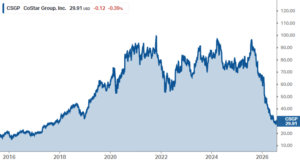
We believe the problems behind this selloff are largely self-inflicted and the opportunity is bound to attract activists.
Despite being founder-led, Andy Florence owns only 0.5% of the company. Over the years, he has prioritized beach houses (we guess!?) over company control. We’re not here to judge. What matters is the CEO controls the company because of his reputation and legacy, not because his investment gives him legal control. CSGP is ready for any activist with deep pockets to buy himself a seat at the table.

Homes.com
While there is a slight slowdown in their core business, let’s dive straight into the real stinker: homes.com.
Blinded by past success, management has decided that commercial real estate has gotten too easy and that they need a $1b side quest.
Homes.com is another Zillow.com, but then better. Hopefully. Zillow monetizes its platform by selling ‘leads’ to potential buyers. Costar markets with “your listing, your lead”, and will charge the listing agent a subscription fee, but will not sell the listing (and half the commission) to a competitor.
What started as a minor $150m acquisition back in 2021 has turned into a monster that CSGP spends a billion a year on. You know you’re spending serious money when Patrick Mahomes knows your ticker symbol.
Costar has sunk a fortune into buying website traffic and has yet to show it can monetize it by selling subscriptions to listing agents. Revenues barely exceed $100m.
The result is a company that does roughly $1.3b in EBITDA in its core, which reported EBITDA of $440m in 2025 due to the losses from homes.com.
Spotting this opportunity, 2 large activist shareholders stepped in in 2025: D.E. Shaw and Dan Loeb’s Third Point.
Both demanded a focus on the commercial business, while scaling back investments on homes.com. An obvious request.
They added 3 new independent directors to the BoD who had the activists’ backing. CoStar launched a new capital allocation committee.
Then CoStar Group told the market it intends to wind down its homes.com investments in stages, with profitability now expected in 2030. Third Point eventually looked at the 2030 profitability timeline and concluded they’d rather be retired by then. They exited.

D.E. Shaw showed more patience, but made it clear they’re watching management. In a letter to the BoD, they demanded more transparency into homes.com’s actual losses.
So what we have here is a CEO who is so intent on showing the world that he can win, that he seems to have lost sight of what this potential victory will have cost the company.
Founder-CEOs are wonderful until they decide they’re no longer running a company but are instead pursuing a personal side quest.

But there is more. There is plenty of research showing the poor track record of companies that spend excessively on new headquarters.
In an office market that is vastly oversupplied (you don’t need CoStar data to know that’s true), CSGP decided to shell out over a billion dollars to consolidate their current campus into 1 building.
We can be convinced of the benefit of having various teams sitting closer together. But why not rent one of those many empty buildings?
Building a billion-dollar headquarters in today’s office market is a bit like opening a Blockbuster in 2026.
Next steps
It looks like, at worst, we have a company trading at 9x the EBITDA of its core business. There are some headwinds to its core business as well, but we defer that discussion to our Discord.
CoStar has committed to winding down investments in homes.com, which should result in roughly a tripling of EBITDA by 2028. If that happens, we think the market will reward CSGP.
On the other hand, if CoStar drops another 10%, activist analysts will start appearing at earnings calls faster than realtors at an open house with free champagne.
The steps to value creation seem clear. You just need a CEO with no emotional link to homes.com. You need some adult supervision who goes back to framing the investment in terms of IRR and NPV.
This isn’t a name where you bet the farm today. It’s the kind of name where you track the activist action and size your position based on whether CSGP keeps on spending its money like Masayoshi Son after seeing another hockey-stick chart, or like Warren Buffett at Dairy Queen.