
As thematic investors, we just love distributors. It is often the most torqued way to express our view on an industry. Low starting margins provide plenty of upside when things go from totally fucked to merely shitty. Don’t even get us started on when they go to totally awesome. Distributors have been among some of our most successful investments.
On top of that, the best-in-class distributors end up being insanely good compounders. The trick is in using your larger scale to deliver value-added services. Whether that is a lumber distributor selling pre-fab roof trusses instead of lumber, a food distributor selling private label, or a chemical distributor offering an easy-to-use IT system for customers to place orders…
Raising margins from 4% to 8% requires marginal improvements but can have a huge impact on your bottom line.
Once you have best-in-class margins in your industry, you’ve added an M&A growth angle to your business. You can acquire subscale mom-and-pops, add your magic touch, and talk to Wall Street about the synergies you generated. Before you know it, you trade at a premium multiple.
It is no surprise that many of the S&P’s most successful companies are distributors: Fastenal and Pool have been monsters. Even Builders Firstsource was among the star performers until a housing downturn and slightly overconfident capital allocation caused their fall from grace.

With that in mind, let’s revisit one of our favorite themes: the aerospace aftermarket. In May of this year, we wrote “Up in the air”, a thematic update on our aerospace theme. We did some victory laps around our specialty alloys theme before pitching a basket of aerospace aftermarket names.
The recent surge in middle-distillates (hoorah for our refiners!) makes the market fear we will forgo a flight to the Bahamas and opt for something more affordable, closer to home. Flight demand could collapse, reducing demand for maintenance.
Sounds logical, except for the repeated assurances from every company (except some glass-half-empty commentary from the GE team, who had to reminisce about the GFC) that the market is fine. Demand hasn’t changed. Demand reflects flight activity over the last 5 years. Maintenance is non-discretionary, and most of the next couple of years have already been fully booked.
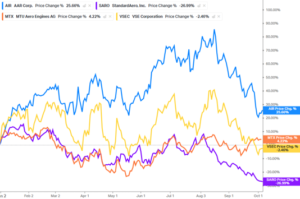
While our aerospace basket ran very strongly after our write-up, today’s market volatility is giving us another chance to buy quality companies with a multi-year tailwind at discounted prices.

As a reminder, our basket consists of AAR Corp (AIR), SARO (Standard Aero) and MTU Aero (MTX GY). We included VSEC simply because it’s a great company, and we hope that one day all our companies will trade at their multiple. We once wrote up AAR on VIC here in case you want some background.
Now why did we start this write-up talking about distributors? Only a few years ago, AAR was best known as a heavy-maintenance MRO business. They’re the guys in coveralls who take care of the fuselage when it comes in for periodic maintenance, charging the airline based on time plus materials. Boring!
But through a couple of successful acquisitions, they significantly expanded their value-add businesses: component repair and aftermarket spare-parts distribution. They also own Trax, the most widely used maintenance ERP for airlines.
The key takeaway is that, like VSEC, they partner exclusively with OEMs to distribute their parts in the aftermarket. Keep in mind that most OEMs make most of their money in the aftermarket. Selling spare parts is the money maker. But an increasing number of OEMs choose to outsource this business to distributors who are better positioned to maximize revenues.
What benefit does AAR have? If you handle 3,000 planes per year and work with all the airlines, you are in a strong position to fit your partner’s spare parts. And if you run the industry’s leading ERP system, you have strong insight into which products are in demand.
Meanwhile, as an MRO with ample inventory and repair capabilities, you help ensure airlines don’t ground their airplanes any longer than strictly necessary.
You could call it a flywheel.

When we wrote this up on VIC last year, this was a theory. But AAR has been consistently beating earnings expectations. Spare parts distribution has grown well north of 20%, and EPS growth last quarter was 38%.
So why are shares down more than 30% in the last month? They announced a large acquisition of MRO Holdings. The market dislikes it. The price is high (14x EBITDA ex synergies). Why take on leverage to do an acquisition when interest rates are rising? And the market wants more of that sexy distribution revenue. Not those boring MRO revenues.
But what they are missing is that growing the MRO business sets them up for more partnerships on the distribution side. They can add more value to their distribution partners.
And value-add is what makes a distributor a compounder