
Look, we love making fun of politicians. If the US Secretary of the Treasury calls himself ‘The House’, days before the bond market blows up, we find that hilarious. The memes practically write themselves…

But after a quick laugh, we are here to make money. With the US10YR well above 5%, that’s problematic for the US economy, not to mention most of EM. With a physical shortage of both crude and refining capacity, demand destruction seems a logical next step.
In the near term, there are two options. Either the US and Iran make up and find some sort of common ground that gets them to sing kumbaya, my lord, around a fire. The world normalizes, inflation moderates, and interest rates come down. We’ll print money on our aerospace names.
Unlikely? Well, that gets us to option number two. Iran will keep chanting ‘death to America’ and this same America will respond by showing why the US government runs a 6% deficit. Call it power plant and bridges day, or call it another Iwo Jima… oil might flow, but at best it will trade with a massive risk premium.
That’s our demand destruction scenario.
This week, the IEA updated its 2026 petroleum demand forecast to -2.6m bpd versus 2025. Have we ever seen such a step back in petroleum demand that did not coincide with a global recession?
Most of that demand destruction might be in Pakistan, where the upgrade from motorbike to car will have to wait another year. But even in the US, every farmer is figuring out ways to cut diesel consumption, and every trucker is finding ways to cut their least profitable routes. And US consumers… by now they must be getting used to tightening the belt another notch.

The scenario we’re describing is recessionary. While that scenario seems hardly priced into the SPY because of the usual tech outperformance, aren’t we getting closer to the point where we all panic-buy bonds?
Have yields peaked? We will leave picking the botttom in treasuries to Mr. Bessent, but with so many people celebrating the bond collapse (us included), we’re starting to lean the other way.
And being long bonds certainly feels like a contrarian trade right now. Bonds haven’t been this underowned since the 60s.
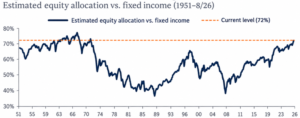
However, buying bonds for a 5.3% yield isn’t paying the bills. They’re great for your parents’ retirement account, but we need something with more torque.
Mortgage Origination
The go-to names to play falling yields are generally in housing and mortgage origination. We wrote up mortgage origination back in February, just before UWMC decided to destroy everybody’s origination margins out of spite. How often does a CEO go on record saying he is willing to lose money as long as it hurts their competitor more? Maybe Apollo is now finally forcing some discipline into UWMC, which benefits the industry?
Rocket (RKT) clearly has a lot of refinancing torque. But if returns merely return to where they were a few quarters ago, who would really refinance? On top of that, we dislike a CEO who feels the need to tell the market on every call that he’s from Silicon Valley, and he’s here to disrupt the market. Meanwhile, Pennymac (PFSI) has made it clear that if UWMC doesn’t destroy their business, they are fully intent on destroying it themselves by overhedging their servicing book.
These are tough buys…
Housing
So what about housing? Let’s discuss our favorite housing play: Builders FirstSource (BLDR). We wrote about distributors last week, and we genuinely think that BLDR is one of the best industrials out there. Their value-add from distributing trusses, rather than just lumber, provides a strong margin boost. It’s not unique or irreplicable, but for an industrial it doesn’t have to be. An industrial needs only to be a few percent more efficient each year than the year before, either by investing in automation or working a little smarter. We have visited one of BLDR’s truss facilities in Atlanta back in 2023, and we believe they have figured out this game of continuous improvement.
And the valuation case for BLDR is clearly there as well. 9x EV/EBITDA isn’t historically cheap, but EBITDA seems below normalized levels, with plenty of upside once the housing market unfreezes.
But what’s really keeping us away is the balance sheet distress they have caused by spending $8b on buybacks and $3.5b on M&A (versus an EV of $10b today). We still remember when BLDR said it would be below 2x Net Debt / EBITDA by the end of 2025. Now they are closing in on 4x.
We want the market to worry about how BLDR will finance its working capital in an upturn. We want every single analyst who talks about BLDR to talk about how long margins can really go. We want every analyst to claim that there is no moat in trucking lumber.
And for that, we want that ugly Q3 print out of the way. We have seen enough companies get slaughtered on earnings that we already knew would be bad. We have no intention of being too early.

So, while we are making fun of Bessent’s bond market, we are preparing to get long anything that’s rate sensitive. We will certainly tune in on the next RKT and BLDR earnings calls.
On refiners
We’ve been victory-lapping our refiners call for a while now, and while it’s been a great call, we’re not blind to the risks our demand-destruction scenario poses for our refiners.
FinTwit currently seems to be in a fight about who’s got the real data on what’s happening in Hormuz. Rather than join that argument with our own theories, let’s look at what the experts (in this case, Kpler) have got to say. After all, they’ve got satellites.
Without getting too precise about the data, crude flows from the Middle East look like they’ve almost fully recovered, while product exports are below 60% of last year’s volumes.
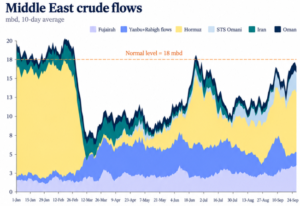
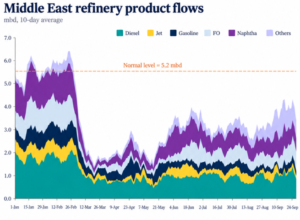
A scenario where crude is plentiful, and refining capacity remains off the global market is goldilocks for refiners. But will it last? We’ve mentioned before that ending SPR releases could end the fun. As could the return of Chinese teapot refiners.
Maybe if we manage to get crude out of Hormuz, it is only a matter of time before we figure out how to do this with distilled products?
And if that isn’t complicated enough, valuing our refiners certainly is. How do you value something that might have 1 or 2 quarters of excess earnings, and then slowly grinds down to a new normal? PBF might still be cheap once it’s deleveraged, but making a valuation case for MPC and VLO is a lot harder.
We wrote about cleaning up our book in anticipation of a potentially rocky Q3 earnings season. We have taken off most of our refiners position. Are we too early, and are we leaving a lot of gains on the table? It wouldn’t be the first time (ugh).

Refiners have been an absolute slam dunk since our initiation in September 2025. It’s been about 13 months, and our basket is up between 164% and 232%. We’re declaring victory and are moving on to the next fat pitch.