
While Americans like to talk about Europe as one nation, the continent has always been greatly divided. The cultural differences are vast. In the eyes of their neighbors, the Dutch are cheap and too direct, the Germans have no sense of humor, the French are arrogant, the Spaniards are lazy, the Italians are chaotic, the Brits just pretend to be polite before they stab you in the back, and the Swedes, Danes, and Norwegians have a century-long tradition of killing each other out of mutual respect.
The long history of conflict is evident in modern-day borders. Switzerland exists so that the Italians can’t place any artillery on the German border and vice versa. Belgium exists so that the Dutch and the French don’t have to share a border. The Netherlands, in turn, exists because the Brits don’t want to have the Germans on the other side of the canal with their U-boats. Ukraine exists so that the Germans can’t march on Moscow in less than a day. And maybe Europe exists in its current form because the US didn’t want the Russians or the Germans controlling the other side of the Atlantic.
For most of history, European countries settled their cultural differences on the battlefield.

Then World War II happened, and in the aftermath, everyone in Europe agreed that this time they had gone a little bit too far. The human toll had been catastrophic, and besides, countries in both the Far East and the West had caught up or potentially surpassed Europe while they had been busy fighting each other.
The European Union started as a project to keep the peace. By intertwining European economies, the economic toll would be too significant to fight any future war. Global peace through global trade.
Despite all of the EU’s flaws, it actually did manage to prevent any major new war, absent the
occasional genocide in the Balkans and an unresolved conflict in Cyprus. Cultural differences are now settled on the football court
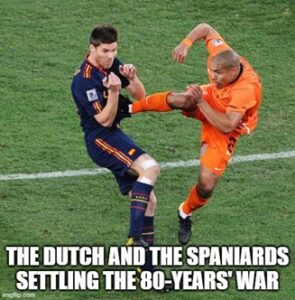
Student exchange programs taught Europeans that, despite their differences, they all share a love of beer and, strangely, a high tolerance for excessive taxes. Germans might have a bad sense of humor, but their engineering is pretty neat, and they are never late. The Italians have a great sense of fashion. The French make good food. Spain is beautiful, and the Brits are the best at telling politically insensitive jokes.
Global peace through global trade drastically reduced the need to spend on defense and diverted those funds to more productive uses in the economy. After all, the economic return on defense spending hasn’t really existed ever since the Geneva Conventions made it a war crime to loot your opponent or to turn them into a colony that could supply you with herbs and spices.
The required investment in defense equaled the minimum you needed to deter anyone from invading your country.
In the eyes of some Americans, Europe has been freeloading on the USA’s defense spending. In the eyes of Europeans, the USA simply spends more on defense because it has a habit of getting involved in yet another war.

For decades, European defense companies have made lousy investments. They didn’t just lack the earnings growth to be interesting investments. Even before ESG departments took the last bit of fun out of being a European investor, defense spending has been off limits for European institutional investors. Defense stocks traded at low multiples because they lacked institutional investors.
That changed in 2022. Following Russia’s invasion of Ukraine, the EU taxonomy, the ESG overlords who decide which industries contribute to a better world, decided that investing in anything related to natural gas was now considered good. As were investments in weapons, provided they were used to kill Russians. Defense became investable again. The industry rerated, while growth accelerated.
Which brings us to today. Needless to say, eighty years of promoting global trade have gone in reverse in just the last couple of years. Old alliances can no longer be relied upon.
NATO Secretary General Mark Rutte is now making the rounds, making the case for higher military spending. The skeptics might find this ironic, given that Mark Rutte’s time as Prime Minister of the Netherlands was dedicated to drastically cutting the military budget.
Whether it is to fulfill the personal ambitions of some European politicians, Europe has now convinced itself that the Russians are coming, and they need to arm up.
The trade was affected in 2022, and we missed it. What used to be an industry trading at trough multiples on trough earnings is now a richly valued industry with earnings the market believes are above normalized levels.
However, we’re here to tell you that the market has viewed European defense as a 3-5-year trade that would be over the moment the Ukraine–Russia conflict ends. If that happens, defense names will inevitably sell off. We’ll be buyers.
But we believe there is a second leg to this trade, driven by a permanent increase in the level of spending considered adequate. If even your closest ally threatens military action against your territory, you’d better arm up.
In 2014, NATO countries agreed to move towards defense spending of 2% of GDP within 10 years. Many countries failed to meet this target. Discussions are now underway to raise this to 3-5%, with more countries planning to comply.
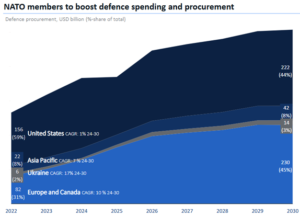
Source: Kongsberg, Janes Information Services
Moreover, the kind of weapons required to fight a modern war is changing. No Western civilization has the manpower to man tanks and drive them to the battlefield. Modern wars are fought by cheap unmanned drones taking out expensive pieces of enemy equipment. This requires a different set of tools made by a different group of companies.
Countries like Germany definitely have the money to pay. While most countries have been running an experiment to see how high government debt ratios can go before something breaks, the Germans feel they’ve already tried that and chose to deleverage the government’s balance sheet. Since 2025, that attitude seems to be changing.
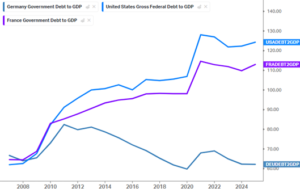
Source: Koyfin
What if Germany had chosen to run a budget deficit similar to the US’s? They would still have gutted their economy by making energy unaffordable, but how much smaller would the growth gap have been with the US? How much can they catch up if their attitude towards debt changes?
Despite this trade feeling somewhat obvious, defense names have actually been grinding down since the start of the Iran war. This is most likely caused by an abundance of recent IPOs (Czechoslovak Group (CSG NA), Colt CZ Group (CZG NA), Vincorion (V1NC GY), Gabler (XK4 GY)). This adds to the long list of existing names: Theon (THEON NA), Exosens (EXENS FP), Hensoldt (HAG GY), Leonardo (LDO IM), Indra Sistemas (IDR SM), RENK (R3NK GY), or Rheinmetall (RHM GY).
As always, no recommendations, but THEON has been mentioned before in our Kliff Notes and would be a good place to start your research given the discounted valuation, strong backlog, and increasing future proofing as it’s moving from analog night vision goggles to digital vision systems, including vision systems for hardware that sell for much higher ASP. EXENS provides the same exposure at a slightly higher valuation, but potentially better capital allocation. CSG and CZG are the value plays but have less exposure to the future of warfare. Also note our short report Kliff Note on CSG.