
Everybody back in the pool!
Did you have a rough couple of weeks? You’re not the only one. That’s the tragedy of financial markets. The world goes crazy on AI stocks, and even when you never touch any of that stuff, you bear the cost when it all comes tumbling down.

Fortunately, with the elections out of the way, an important source of uncertainty has disappeared.
Last Tuesday, the American voter made it known that they are once again willing to accept men competing in women’s sports, as long as the US can bring an end to a war that nobody asked for and which directly impacts the cost of living for nearly everyone.
That Americans care about the price they pay at the pump shouldn’t come as a surprise. Neither does the blue sweep – prediction markets had the odds around 70% prior to election day. But we all need to be reminded every election cycle that this is almost irrelevant for the direction of stocks.
There is a long history of data that shows that US stocks tend to go up regardless of who is in office, with the exception of 2001-2009 – a period which included 2 wars in the Middle East as well as the GFC.
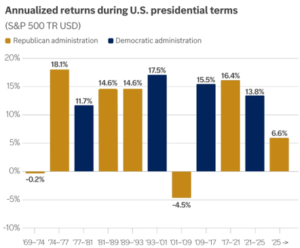
Source: Morningstar Direct, Edward Jones. S&P 500 Total Return Index, January 20, 1969–March 29, 2026.
Yes, this shows performance during presidential terms and it shows that it doesn’t really matter which party got to install the top dog. There is similar data on congress. Of course it matters for certain industries, but for broad market indices, historically it has been irrelevant.
And do Democrats want to be responsible for losing the AI race to China? We don’t think so.
We’re not here to make a political point. Remember, we’re not even involved in US politics. We just see many market participants who have gotten too passionate about their political beliefs. At the end of the day, we’re only in a game of picking companies with growing profits and high cash flow generation.
Call it a sell-the-rumor, buy-the-news moment. The data going back to 1928 shows that markets underperform in anticipation of midterm elections, only to rally into the last 2 months of the year.
Seasonals are setting us up for a good next couple of months.
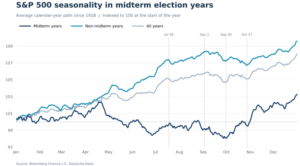
Source: Bloomberg, Deutsche Bank
That doesn’t mean that all risks have disappeared.
Going forward, the two datapoints that seem to matter most for markets are Anthropic’s ARR and the price of oil.
You know our stance on AI. There isn’t nearly enough revenue to justify a trillion per year in Capex. To top it off, 2026 will be the year when the market convinced itself that semis are no longer a cyclical industry. It’s been a dumb couple of years and it all deserves to unwind.
On the price of oil… we were outspoken back in March that opening the Strait of Hormuz wasn’t going to be easy. Eight months into the conflict, we have no idea whether this will end in bridge-and-powerplant day, or whether the world will just figure out how to export crude from the SoH. People are inventive. Getting oil out seems to be the world’s #1 priority… so won’t we just figure it out? Will Iran get a not-so-friendly call from Xi asking them to cut it out? Won’t crude revert to trading at ‘normal’ prices, plus maybe a small risk premium? If it’s going to re-escalate, it should be in the next few weekends. But this long into the conflict, it no longer pays to be a bear.
But other than historic data, we are looking at our PM friends and the last few months have just been miserable. Everyone seems to be down a bunch, both on an absolute and relative basis. Bill Ackman is giving interviews saying that markets are broken. Our smartest friends are hiding in cash. We’re not saying they are contras… just that doing fundamental work has not paid off for a while. And those things tend to go in cycles.

The list of Hedge Funds having blown up is getting longer and longer. Walleye might make the headlines, but there are plenty more. We’re often told we’re dinosaurs for thinking we’re still all playing a fundamental game – the markets have become a positioning game. Well, it turns out that everyone was positioned levered long the same couple of names, and we’re now being presented with a vast opportunity through forced selling.
Maybe redemptions and tax-loss selling will continue into year end. But we just can’t help ourselves: when we see forced sellers, we want to lean in.
The book
Fortunately, we have a bunch of cash to deploy. Remember those quality compounders we kept talking about? We’ve had a decent squeeze in those names. Stryker (SYK) is up a bunch despite weak earnings. We’ve exited.
We also recently closed our long position in refiners, Brazil and for-profit prison stocks. While refiners have been knocking it out of the park in Q3, we probably nailed the peak in crack spreads and we expect the market to normalize… slowly. You don’t want to overstay a position in a cyclical once the cycle has peaked.
We’re happy we exited our prison stocks. Locking up foreigners might have been a bull market under Trump… but long term it is a questionable business, given that a large part of it is locking up immigrants for processing… not as a punishment. ICE populations peaked shortly after the battle of Minnesota and have since plateaued. We are happy to be out before the market starts to wonder what sort of exit multiple to put on a business where terminal value depends on which political party is in charge.
We also correctly called a bottom in bond yields a few weeks ago. But while we bought long-duration bonds for all our family members, we stayed clear of the higher-torque, interest-rate-sensitive equities. Builders FirstSource (BLDR) went on a tear, despite an awful outlook for 2027. Yes, the business seemed to have stabilized last Q, but the slowdown in housing demand will work its way through into housing starts with a lag. We think we’ll get another shot at this one as 2027 will probably end up below 2026.

So, what are we buying?
Long Vol
We’re still long our vol basket. Or who are we kidding… our so-called basket consists of one stock only, which is Marex (MRX). Marex is having a banner year with more than 50% profit growth. While they are benefitting from the increase in volatility, we believe a lot of the growth is underpinned by durable market share gains. With interest rates up, the market no longer fears NII sensitivity.
MRX peer StoneX (SNEX) has given up most of its YTD gains, which is a shame, because it might dampen our expectations on multiple expansion. Still, MRX guided to 10-20% earnings growth next year which gets us to EPS of $8.80. 81x P/E for a company that keeps finding ways to deploy capital at 30% ROE is a steal.
StoneX also went big with its acquisition of RJ O’Brien. While further consolidation in the industry makes sense, the acquisition wasn’t cheap, and our contacts tell us that RJO was already operated lean… with very little fat to cut.
Marex has a very successful M&A track record and we believe that the recently announced acquisition of Bright Point International can be another transformative transaction, opening Marex up to the Asian market. A deep dive on Marex’s M&A potential is still on our to-do list.
Aerospace
Did we pester you enough about aerospace? The valuations on some of our preferred names (AIR US, SARO, VSEC) had become downright silly, with SARO trading at a low-teens P/E, as is AIR if you look out 1 year and model their recent acquisition of MRO Holdings.
Meanwhile they’re all in a raging bull market with >10% organic growth (VSEC just reported 17 org growth), underpinned by growing backlogs. Yes, their customer base is having a hard time with the price of jet fuel, but the MRO shortage is so severe that no airline will risk giving up their MRO slots.
We’re very long AIR… Admittedly, for this to really work, it would help if one or two major wars came to an end. There is some cyclical risk. But at the end of the day, demand for MRO services is a function of how much a fleet of airplanes has flown during the last 5 years… As long as oil prices and flight activity return to normal in the next year, we think we’ll print money on this one.

Specialty Chem
We recently did a 2-part deep dive on this underfollowed sector.
Q3 trading updates from IMCD (IMCD NA) and Azelis (AZE BB) showed us that the trend is continuing. Growth is accelerating. So why haven’t shares really budged? The growth is, not surprisingly, coming more from commodity chemicals, as opposed to the specialty ones. From industrials instead of life sciences. Growth is coming from pricing instead of volume. And to top it off, higher growth means a buildup in working capital and leverage ratios haven’t come down (yet), which is considered too risky for the largely European shareholder base.
The last ingredient that’s missing for this sector to really work is a recovery in end-market demand. A recovery that is driven by strong demand and not merely a supply shortage. For now, we are happy with the return to an 8% organic growth rate, knowing that we bought this at a trough-multiple at trough margins.
Trade schools
We’re also still in trade schools, but would like to defer updating on this theme until after earnings. As we wrote about earlier, the Google search landscape seems to have changed for the worse and judging by earnings calls from Reddit (RDDT) and Phoenix Education (PXED), this creates too much uncertainty for us to say anything sensible about the next few quarters. We will update on this theme soon!