
Korea’s shareholder reforms are real.
Korea’s KOSPI benchmark index has been on a tear. In the past year, the index has essentially tripled on the back of the success of SK Hynix, Samsung Electronics, and other Korean ‘AI bottleneck stocks’ that everyone is piling into.
However, if you look beyond the KOSPI index, there’s still great value in most Korean small caps. Many of them still trade at single-digit P/E multiples. And now that Interactive Brokers and Chinese broker Moomoo have finally opened up access, you can invest in these stocks yourself.

When I first started investing in Korean equities in 2014, I was told that local equities would always trade at a typical ‘Korea Discount.’ Investors have widely believed that Korean companies should trade at lower valuation multiples than their global counterparts.
There were three main reasons behind the Korea Discount:
Faced with high inheritance taxes, Korea’s entrepreneurs did everything they could to push down the prices of their shares. That way, the basis of calculation for the inheritance tax would be as low as possible. And by paying out meager dividends, they avoided unnecessary dividend tax. If cash eventually built up on the balance sheet, they often siphoned it out through related-party transactions, as there were few repercussions for doing so. The government should not have been surprised by the distortions the tax system caused for us minority investors.
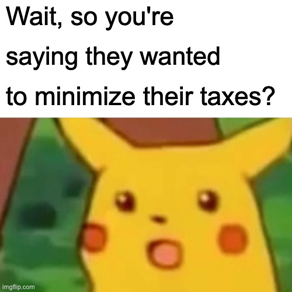
The talk about reforms began in 2023. At that time, Japan’s Tokyo Stock Exchange introduced its shareholder-value reforms. The idea was to, more or less, shame its publicly listed companies into improving their returns on capital and, if they were trading below book, publicly explain why.
It worked. Envious of Japan’s success, Korea’s Financial Services Commission and the Korea Exchange launched their own Value-Up program. The main pillar of that program was to encourage Korea-listed companies to publish reports on how they would improve their corporate value. Just as in Japan, companies were encouraged to set return-on-equity targets and discuss how performance was to be improved.
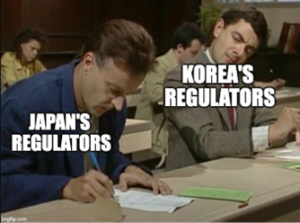
Today, if you go to any Korean publicly listed company’s website, you’ll find slide decks outlining their plans to realize shareholder value. And in some cases, these plans have led to material headway in capital returns.
To further incentivize companies to comply, the Korea Exchange also launched a Korea Value-Up Index – a ranking of the better-performing companies based on its key performance indicators. The index has been a success, with over US$2 billion in assets under management tracking it, much of it from Korean pension funds.
I was initially skeptical of the reforms. If the issues with the high inheritance and dividend taxes, as well as related party transactions, weren’t resolved, then why would companies care? The Value-Up plans were voluntary, so I figured many would just go through the motions.
But I was wrong. We’ve seen a massive change in the past year. In July 2025, the legislature took a major step forward by approving an amendment to Korea’s Commercial Act that required directors to act in the best interests of all shareholders. Today, if a controlling shareholder tries to steal assets from a listed company, the directors could easily face shareholder litigation. So there’s suddenly a lot more resistance to minority abuse than in the past.

And more recently, there have been reductions in both inheritance and dividend taxes. The government has now temporarily reduced dividend taxes to 14-30% for high-dividend-paying companies. And when it comes to inheritance tax, there’s finally talk about using Price/Book to calculate the taxable asset base, perhaps as early as 2028. That will solve the entire issue of insiders not caring about the share price.
Finally, starting in March 2027, every company on the KOSPI will be required to provide English-language disclosures to its investors. So us foreigners will no longer operate at a relative disadvantage.
So change is finally afoot. If the inheritance tax issue is finally fixed, I think the Korean equity markets will be off to the races, with foreigners returning after years of neglect.

There is a lot of excitement right now about KOSPI and the memory chip stocks:
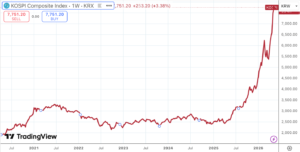
But I’m convinced that the memory chip cycle will eventually turn. I don’t think you’ll want to go anywhere near these stocks at this point of the cycle.
Smart people are now moving into small-caps, benefiting from corporate governance reforms. They track the newly released Corporate Value-Up plans on the KRX website. They try to figure out which of the companies are actually serious about improving their performance. And then they try to front-run cost cuts, share buybacks, Treasury share cancellations or corporate events.
Activists are paying attention, too. In a recent interview, Joe Bauernfreund, of Asset Value Investors, said he had started shifting capital away from Japan to Korea. Activist investor Dalton set up an office in Korea last year. Oasis has also been adding to its headcount in Korea.
I run a newsletter, Asian Century Stocks, covering Asian equities, and I’ve covered some Korean stocks in the past. Three of them still look quite attractive to me:
Other than my newsletter and the KRX website, I recommend following independent analyst Douglas Kim on Twitter. Also, check out redeye23 and jt1882 on Value Investors Club, as I know that both of them continue to look for ideas in small-cap Korea.
Michael Fritzell
Check out asiancenturystocks.com if you’re interested in deep dives on Asian value stocks.