
We’re taking a short break from our thematic review series because spin-off season is upon us.
In just the past few weeks, we’ve seen Octave Intelligence (OCTV), Honeywell Aerospace (HONA), and Mobility Global (MBGL) begin trading as standalone companies. Coming up next is Midera Food Processing (MFP), which is expected to hit the tape this Tuesday.
Spin-offs are about as plain vanilla as event-driven investing gets. Despite their simplicity, spin-offs have consistently been one of the richest hunting grounds in event-driven investing. The reason is straightforward. Shareholders who wanted Company A suddenly wake up to find they own Company B, and many of them have no interest in keeping it. The resulting indiscriminate selling often creates attractive entry points.

But there’s more. Understanding why management is doing the spin often tells you where the opportunity lies. Spinoffs can be done to ‘unlock value,’ which often means a business wasn’t getting the love it deserved within a larger conglomerate.
Or sometimes a company can be run more efficiently with better focus. As part of a larger conglomerate, they may not have been given the cash to reinvest in their business, or they may simply not have received enough management focus. Stand-alone companies also have an easier time offering stock grants in the businesses they control, rather than in a much larger business over which they have no control.
We mentioned that indiscriminate selling tends to create opportunities for investors. This indiscriminate selling is most pronounced in cross-border spins (OCTV) or in spinoffs where the SpinCo is many times smaller than the RemainCo.
Cross-border spins are rare, but they can be very lucrative. Imagine a Hong Kong-listed company listing their subsidiary in the US. What happens to every institutional owner whose mandate is only to own HK-based companies? Or to a domestic retail investor who only invests locally? They are all forced sellers. Furthermore, the SpinCo has to build an entirely new shareholder base. It needs new sell-side analysts, and most of its future investors have never even heard of the company.
That happened when SharkNinja (SN) was spun off from JS Global (1691 HK) in 2023, leading to significant forced selling despite the company trading at very low valuations.

It also happened more recently, when the Swedish company Hexagon (HEXAB SS) listed its industrial software business in the US under OCTV. To avoid immediate forced selling, they also listed Swedish Depository Receipts (OCTV-SDB SS) in Sweden, but this security will be eliminated after 2 years and has not managed to stop the volatility.

At $16, OCTV trades around 12.7x 2026 FCF, but this could fall to 10x by 2028 as FCF conversion improves. OCTV sells industrial software. Think of an engineer making a 3D model of a refinery he’s building. The 3d model immediately tells procurement which pipes to buy. In theory, it could also be used as asset management software by the maintenance engineer who operates the refinery after construction is complete.
We’re lukewarm on the business. First of all, we actually used their Intergraph software 15 years ago and do not think it is exactly state-of-the-art. Second, the company is touting very high ARR growth, but fails to mention that this comes at the expense of its transaction revenues. It is the classical J-curve that we have seen with every software name when they transitioned to SaaS. Revenues will slow down before we see a real acceleration. Until then, this is an lsd-msd growth company, and a low-teens FCF multiple seems about right.
Mobility Global (MBGL) is the typical example of a SpinCo that is many times smaller than the RemainCo. Imagine an institutional PM who’s got 50 positions of 2% each. All of a sudden, he wakes up and finds a 20bp position in a company he’s never heard of. He doesn’t have a model, hasn’t spoken to management, and couldn’t explain the business to his investment committee if asked. He ignores it for a week, but his colleagues keep bugging him about it. “What does this company actually do?” Selling quickly becomes a much simpler solution than setting up a call with management and building a model from scratch.
MBGL is being spun out of S&P Global as the former IHS Mobility business. CARFAX is the crown jewel, accounting for roughly 65% of revenue, with the remaining 35% from B2B assets, including automotiveMastermind, Polk Automotive Solutions, and Market Scan. While data businesses are no longer in vogue, they are built on proprietary datasets that cannot be scraped from the internet.
The setup has all the usual spin-off ingredients: MBGL is less than 10% of the parent’s market cap, has limited overlap with legacy SPGI holders, and sits in an information-services sector that has been de-rated on AI fears. Yet management still targets 7.5-10% organic growth, modest margin expansion, and intends to return 75% of free cash flow to shareholders.
It’s a decent-quality business that was not getting the love it deserves as part of SPGI. At the right price (probably <$20), we’re buyers.

It’s been many decades since conglomerates traded at massive premiums to the market. Conglomerates used to be hot: they provided diversification and were therefore awarded higher multiples. This higher multiple allowed them to do accretive M&A using their shares as currency. Alongside REITs, conglomerates were perhaps the clearest illustration of George Soros’ theory of reflexivity.
Over the past two decades, that dynamic has completely reversed. Today, complexity is punished rather than rewarded. Conglomerates almost invariably trade at a discount to the sum of their parts as investors prefer focused businesses with clear capital allocation, transparent financials, and pure-play exposure. The result has been a wave of corporate breakups, with management teams increasingly concluding that the easiest way to create shareholder value is simply to split one company into two.
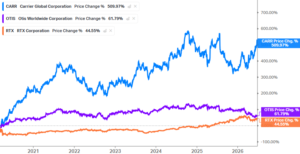
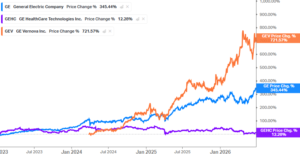
It is hard to say whether the SpinCos performed well because of improved focus or because some of the businesses got lucky and caught massive tailwinds. CARR’s spin in 2020 came just ahead of the housing bull market, which supercharged demand for its HVAC products. GEV caught the AI-driven tailwind for power infrastructure, and GE itself benefited from one of the strongest aerospace cycles in decades.
That is precisely why we spend so much time on thematic investing at KEDM. When a great spin-off meets a great theme, that’s where the real money is made.
Honeywell (HON) is in the middle of dismantling one of America’s oldest industrial conglomerates. The process began last year with the spin-off of its Advanced Materials business, now trading as Solstice (SOLS). This week, shareholders received Honeywell Aerospace (HONA), while the remaining company will become a pure-play automation business.
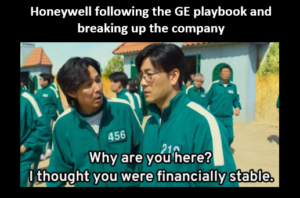
This breakup was orchestrated by Elliott, which disclosed a stake of more than $5b back in 2024. Elliott estimated this breakup could unlock 50-75% upside and thus revived a breakup thesis that Third Point had unsuccessfully advocated back in 2017.
Honeywell Aerospace is the crown jewel of the breakup. The company is a market leader in auxiliary power units (APUs), avionics, flight controls, and navigation systems. They target 7-9% organic growth and believe they have a 200-300bps margin-expansion runway, leading to 14% EPS growth. Not bad for a low-20s P/E.
But the real upside is the potential to outperform those targets. With most of the industry growing well in the double digits, those targets seem beatable, especially with more management focus.
The obvious conclusion is that HONA is the gem. Maybe. As we learned from the United Technologies breakup, where most investors viewed Otis as the obvious winner, the real value ultimately emerged elsewhere. Don’t be surprised if SOLS or even the remaining HON ends up producing the best returns.
Not all SpinCos are set up to succeed. Increasingly, spin-offs have become a convenient way for parents to dispose of businesses burdened by debt, weak growth, or difficult liabilities.
IBM saddled Kyndryl (KD) with $3b in debt at its 2021 spin, despite KD’s need to reinvest heavily and diversify away from IBM. KW Kellogg (KLG) was heavily indebted at the time of its spin in 2023, despite operating in a no-growth category. Merck did the same with Organon (OGN). Aramark set up Vestis (VSTS) for failure, and Becton Dickinson never gave Embecta (EMBC) much chance for success.
Chemours (CC), spun off from DuPont in 2015, wasn’t just loaded with excessive debt; it also had PFAS environmental liabilities that were difficult to value and for which investors would require a massive discount.
The common denominator is simple. They all failed because of excessive debt, while earnings would drop because of stand-alone costs or the need to reinvest.
In general, if a spinoff seems heavily indebted, it is often set up to fail. If it also requires substantial reinvestment, it’s worse.

Some spin-offs are marketed extremely well. Management hosts an Investor Day, lays out long-term financial targets, and spends weeks educating investors and analysts about the business. By the time the stock begins trading, much of the work has already been done.
Others take the opposite approach. They quietly hit the tape with little fanfare, limited sell-side coverage, and almost no investor awareness. That may not be an accident. Management has every incentive for the stock to trade poorly if their option grants are struck shortly after the spin.
We still remember Viemed (VMD), a U.S.-based respiratory care business that was listed in Canada around Christmas 2017. The shareholder base barely knew what it owned, liquidity was poor, and almost nobody was paying attention. Management subsequently created enormous value for themselves and their shareholders.
One final lesson from following spin-offs for years: don’t just study the business. Study the transaction. Why is it being spun? Who is forced to sell? Is management trying to maximize value or minimize the option strike price? Those questions often matter just as much as the financial model.