As we approach the middle of the year, it feels like a good moment to revisit some of the thematics we have introduced over the past few quarters.
In general, we intend to provide more follow-through on the ideas that we mention: both on the thematic and the ED side. None of that “remember that tiny kliff note 5 months ago, turns out there was a lot of alpha in this”. When we believe something is worth watching, we’ll keep you updated. As an example, it would have been difficult to miss our stance on Marex (MRX).

Some themes, however, are more fluid and require regular updates. Those are coming. It will take us a couple of weeks to cycle through everything that remains on the board. We’ll make sure to revisit Brazil ahead of the October elections and our payments theme while valuations remain near all-time lows.
But first some housekeeping.
Over the last six years we’ve covered a host of interesting thematics. Remember Monero, Saudi Arabia, Japanese stockbrokers, platinum group metals, Turkey, RoRos, fertilizer, newspapers, Venezuela, or REITs? Since we’re not actively involved in any of those themes today, we’ve removed them from the thematic monitor.
They’re not forgotten, and we may still be following them, but we don’t want to clutter the monitor and distract from what matters most. If an older theme interests you, you can always dive into the archive or reopen the discussion in our Discord channel.
Kuppy recently discussed trade schools as an overlooked beneficiary of AI.
In short: if software can increasingly handle entry-level white-collar work, the value of the traditional four-year degree may come under pressure while careers that require physical presence and manual skills become relatively more attractive.

This shift was already underway long before ChatGPT. College costs have exploded, student debt has become a national issue, and employers have struggled to find electricians, welders, mechanics, and HVAC technicians. AI may accelerate these trends by making office work more efficient while leaving skilled trades largely untouched. If Gen Z concludes that the safer career path is learning a trade instead of pursuing a generic business degree, then companies such as Universal Technical Institute (UTI) and Lincoln Education (LINC) stand to benefit.
Both are companies we have followed for many years. Back in the 2010s, for-profit education was a volatile industry, with weak margins and profitability largely dependent on which administration was in charge. Obama’s Gainful Employment Rule had devastated the industry from 2010-2016. UTI and LINC emerged as survivors, helped by the fact that a 1-year trade program that prepared their students for $70,000-$100,000 skilled jobs offered far better ROI than most other university degrees.
Over the last 8 years, both companies focused on fixing the legacy business. By increasing campus utilization and adding new programs on existing campuses, they drove margins. Improved marketing efficiencies improved student starts.
What were once barely profitable businesses are now achieving steady EBITDA margins of 13%.
UTI diversified beyond blue-collar trades into health care through the Concorde acquisition. Lincoln has embraced the hybrid model: theory classes over Zoom, with the technical hours done in person. This freed up campus space and increased overall student capacity. LINC will tell its investors that it currently operates at 57% capacity, and that any additional student will come at an 85% contribution margin.
This newfound stability set up both companies for reinvestment opportunities. To benefit from the strong demand for skilled trades and to further drive scale advantages, they both laid out ambitious growth plans, including the buildout of new campuses and the introduction of new programs on existing campuses.
So what is the market missing?
In our view, management guidance appears conservative. We don’t pretend to know the future better than UTI or LINC management, but with a bit of digging, you’ll quickly notice that many of the assumptions leave room for upside. UTI assumes its new Atlanta campus will enroll 1,500 students, while its capacity is closer to 3,000. Add a few more programs, one or two more students per class, or maybe even a midnight welding class, and the economics start to look very attractive.
| LINC | UTI | |
| EV | $1.4b | $2.3b |
| Guidance Period | FY2030 | FY2029 |
| Revenue Target | $850m | >$1.2b |
| Adj EBITDA Target | $150m | $220m |
| Implied EBITDA Margin | 18% | 18% |
| New campuses | 2 campuses / yr | 2-5 campuses / yr |
| New programs | ~20 / yr |
Source: LINC and UTI investor presentations and earnings call transcripts
New programs such as welding, HVAC, or aviation are already at 100% capacity, but the core auto/diesel programs run at 50% capacity. Remember that 1 extra student in the same class will come at an 85% contribution margin. You just need to adjust your utilization assumptions slightly to overshoot their guided FCF by 2x or 3x.
And unlike a 4-year MBA program, which can leave a student with considerable debt and questionable job prospects, trade programs are surprisingly affordable (for US standards)
A 51-week $35k auto/diesel program can often be financed by a $10k Pell Grant (1.5 years of credits compressed into 1 year), a $15k student loan, $5k family money, and a $5k loan by the school (60% of which will never be repaid, but it allows the schools to price up to anyone’s ability-to-pay).
We doubt that the typical high schooler thinks of his choice of study as an ROI-maximizing exercise, but if he does, learning a trade might still be the right choice for many Gen Z.
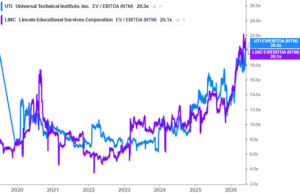
Multiples are much higher than they were five years ago, but the quality of the businesses has improved tremendously. Demand remains strong, with revenue growth at LINC running well above 20%, while EBITDA is currently held back by a step-up in growth investments.
UTI says 2026 EBITDA will be reduced by roughly $40 million due to these investments, but if you dig into the numbers, the increase in spending appears to be well above that figure. Management appears conservative in most of its investor communications.
UTI is currently in the middle of a new investment cycle. Earnings are actually coming in negative year over year as the company ramps new campuses, new programs, marketing, and overhead. We expect that to reverse beginning in fiscal Q4 2026. We are long ahead of this inflection, although we wouldn’t mind another buying opportunity following the expected weak Q3 comparison.
We are adding this theme to our monitor, with UTI and LINC as our preferred plays.

Let’s address the stinker of the last year.
In December 2025, we flagged the reimbursement changes in the wound care space. After years of abuse, CMS cut reimbursement rates for grafts by roughly 90% on January 1st.
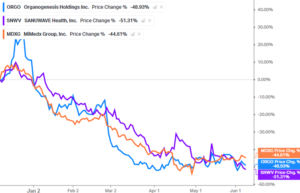
We called out MiMedx Group (MDXG) and Organogenesis (ORGO) as clear losers given their direct exposure to impacted products. MDXG saw a 60% decline in wound care revenue, while ORGO saw a 63% decline.
Meanwhile, we called out Sanuwave (SNWV) as a potential winner. They grew Q1 revenue by 3%, which is great compared to peers’ -60%, but still a step down from the 35% growth in 2025.
Despite the relative difference, all three companies are down roughly 50% YTD.
We’re surprised by the magnitude of the selloff in SNWV, but we also recognize that we underestimated the extent to which industry-wide uncertainty would weigh on the company.
By late 2025, it had already become clear that many providers were spending more time explaining their vintage car collections than treating new patients. That uncertainty has continued into 2026. On top of that, a number of smaller providers, particularly in the mobile wound care space, have since gone out of business.
Technical factors have also amplified SNWV’s underperformance. The company is scheduled to leave the Russell 2000 on June 26, while its largest shareholder, Opaleye, continues to sell stock. Few investors are willing to step in until this potential two-million-share overhang has cleared. At least the index selling should be behind us in a couple of weeks.
For a small company like SNWV, this volatile environment also creates operational challenges. In 2025, it ramped up its internal sales force, hiring representatives with cardiovascular rather than wound-care backgrounds. At the same time, wound care distributors suddenly found themselves without expensive skin grafts to mark up, creating significant demand for SNWV’s products. Finding the right balance between an internal and an external sales force becomes complicated when territories overlap.
There is also an ongoing shift from mobile wound care toward hospitals. Hospital sales cycles are longer and often require a constant sales presence to drive adoption. Reimbursement rates may be somewhat lower, but the value proposition is increasingly tied to reducing hospital length of stay. We think SNWV will figure it out, but for now sales trends remain somewhat underwhelming.
To wrap it up, the share price performance has been disappointing. The slowdown in growth partly justifies that. SNWV’s CEO believes growth will reaccelerate during the second half of the year. We’ll wait for the first signs of that happening before becoming more aggressive.