
Even though we consider ourselves value investors, we are only interested in investing in industries with a tailwind. Most consumer businesses have been struggling for the better part of 4 years, and despite rock bottom valuations, consumer is a hard place to make money.
With that in mind, let’s talk about what has been fueling the universal soldier for many centuries: nicotine. Some of us portfolio managers might think of our trading as being in the trenches. In reality, being in the trenches means being cold, wet, and hungry. Nicotine seems made for dealing with those discomforts. Admittedly, depending on how miserable or hopeless the war they are fighting, some soldiers opt for heavier artillery, but nicotine remains the baseline.
While consumption of nicotine goes back centuries, the delivery method of this nicotine has changed more recently, mostly after we figured out that lighting nicotine on fire and inhaling it isn’t exactly a longevity play.
But let’s skip over cigarettes and cigars, and go straight to how our Viking friends in Sweden like to get their nicotine hit, starting with Snus.
Snus finds its origin in Sweden and dates back to the 18th century. Snus is a moist, smokeless tobacco placed under the upper lip that delivers nicotine without combustion. If you’ve ever sat across from a Swedish CEO on a roadshow, odds are he had a lip full mid-meeting. Consuming Snus is more ingrained in Swedish culture than beating up on their Norwegian or Danish neighbors. It is as much part of their culture as going on a weekend booze cruise into international waters to avoid excessive excise taxes on alcohol.
In the mid-2010s, a company called Swedish Match figured out that removing tobacco entirely could further reduce perceived health risks. They called this product Zyn, the first commercialized tobacco-free nicotine pouch.
Snus has been banned in the EU since 1992, but when Sweden joined the EU in 1995, it negotiated a permanent exemption to avoid a national revolt. As a result, Sweden now enjoys some of the lowest smoking and lung cancer rates.
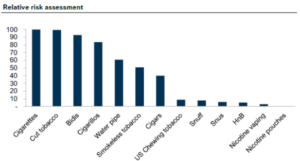
Source: Haypp, F1000Research
So, the nicotine pouch manufacturers are selling their product to regulators based on their relative health benefits versus cigarettes. While the stats are convincing, that’s not a debate we get paid to have. Remember this?

Instead, all we care about is that the demand is real and growing rapidly, and there is money to be made in this industry.
In the last couple of years, Nicotine pouch consumption has slowly started to take over from Snus consumption. Nicotine pouches began being sold outside Sweden in Norway, the UK, and the US. Unlike Snus, the EU has not formally banned nicotine pouches but leaves it up to the member states to regulate them – for now.
The result is that nicotine pouches are one of the fastest-growing consumer goods categories of the current times. In today’s consumer recession, it is hard to find consumer goods with a tailwind. But nicotine pouches are one of the few products that fit that bill.

Source: Haypp
Outside Sweden, NP sales took off after Swedish Match was acquired by American Philip Morris in 2022. While most of the EU is off limits, Norway is an important market, as are the US and the UK.
Some would argue that the US is a natural fit, given its history with chewing tobacco. Compared to chewing tobacco, the benefits of NP aren’t really health-related. The benefit is that you don’t look like you’re about to spit on the floor.

While the market potential in the US is many times larger than in Sweden and Norway, the dynamics are very different. In Sweden, the market is mature and largely saturated, with pouch growth mostly cannibalizing Snus.
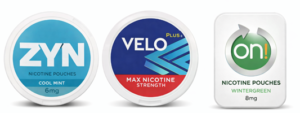
In the U.S., it is more fragmented and experimental. The large players include Philip Morris (PM)’s Zyn, British American Tobacco (BTI)’s Velo and Altria (MO)’s On!. There are some niche brands, of which Alp is the most notable because of its promotion by Tucker Carlson. It is owned by a JV between Tucker and Turning Point Brands (TPB). TPB is widely covered in our Discord channel, mainly by KEDM subscriber @stonksbusinessman.
As a first mover, Philip Morris’ Zyn had ~76% US market share until it faced supply bottlenecks about a year ago. Zyn used to be priced at a ~30% premium to competing products.
Surprisingly, Velo has been the market leader anywhere outside the US. Their US product was reportedly subpar (we never tried… don’t get high on your own supply and all). BAT introduced Velo Plus in December 2024 and has been taking share since.
What has transpired over the last few years is a price war, in which Philip Morris is giving up its premium pricing to stop bleeding market share to new entrants.
The real story here isn’t about demand growth but about fragmentation and a full-blown land grab on the supply side.
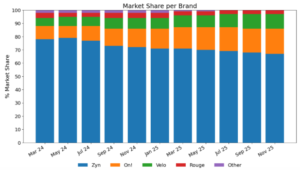
Source: company data
A final noticeable difference between the US and more established markets is the distribution channel. In Sweden, 36% currently sell online, while the US is stuck in the 2-3% range.
European vendors often carry a much wider range of brands, flavors, and higher nicotine strengths than what is sold in the US. As a result, Americans like to shop for illicit European imports, something that customs has been slow to crack down on.
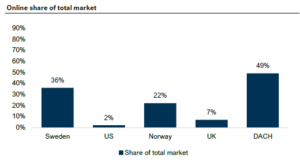
Source: Haypp
Which brings us to the only nicotine pouch and Snus pureplay that we are aware of: the Swedish company Haypp (HAYPP SS), which runs a dominant e-commerce platform focused solely on nicotine pouches and Snus.
Haypp has an online market share in the 65-90% range and arguably benefits from some scale advantages. They offer a wider assortment, a direct supply agreement with PM gives them lower prices, which they share with their customers, and satisfied customers result in higher organic search rankings.
But more importantly, they make most of their money on what they call ‘media & insights’.
Media refers to paid placements on their website. After speaking with big tobacco companies that are late entrants in NP, it is hard to promote a new brand in a market where marketing is heavily regulated. Haypp’s insights allow them to build brand awareness.
In turn, ‘Insights’ is a monetization of all the consumer data Haypp has collected on its customers. What is the best timing for a promotion, and which users should you target? Why did people stop using your products (taste, price, competing brands)? All questions for which the answer is invaluable when trying to position your new product.
In a market where consumers like to experiment, and where big tobacco is in the 2nd year of a land grab, Haypp’s media & insight is the enabler of this increasing competition.
While this trend isn’t new, most of the companies we mentioned aren’t pure-play Nicotine Pouch companies. So even though we’re already a few years into a bull market, we are only just beginning to reach a point where nicotine pouch sales are having a material impact on most companies’ bottom line.
Furthermore, given that we’re in a heavily regulated space, the industry tends to sell off a couple of times a year due to regulatory scares. This creates occasional buying opportunities. The latest one was a recent Reuters article that noted the slow progress in the FDA granting product approvals for the US market.
Zyn was the first product to receive the FDA’s Premarket Tobacco Product Application (PMTA) authorization in January of 2025, 5 years after its application. In September 2025, the FDA launched a pilot program to streamline this process. Under this program, 6 On! Plus products were authorized in December 2025, after only 3 months of FDA review; a dramatic acceleration. However, since then (a mere 4 months ago), no products have received authorization. Reuters’ observation of this caused shares to crash by 10-20% in early April.
This could be the sign of changing attitudes at the FDA, for instance, because of a more cautious stance given the risk that children become NP users, not dissimilar to what’s happened with vaping. It could also just be the result of dealing with a bureaucratic government agency.

In conclusion, we live in a world where consumers are under increasing pressure. In this tough environment, Nicotine Pouches have grown at a tremendous rate, and we want exposure to this category.