
From White Monkey to Project Shitadel
Freddy Brick has been with Muddy Waters since 2014, but he got there in a fairly roundabout way. He graduated into the 2009 European job market. At one point, he was down to a final-round interview at Bank of America, only to find himself competing with candidates flying in on private jets.
So he left. China at the time was running peak, unfiltered capitalism. Freddy ended up working as a white monkey, essentially a Western interpreter trotted out by SOE chairmen as a status symbol. From the outside, it looked like proximity to power. In reality, it was closer to a prop in a system that had little interest in IP protection or the rule of law.
That experience turned out to be useful. It gave him a feel for how gray markets actually function, which eventually led him to Carson Block and Muddy Waters. Over time, the firm has expanded well beyond China fraud into a mix of strategies, including junior mining and emerging markets. Freddy refers to it, only half-jokingly, as Project Shitadel. The idea is to find smart, slightly misfit investors and let them operate outside the constraints of a large multi-manager.
AI and the Compression Trade
Freddy’s current bearishness is driven by a recent rabbit hole involving Anthropic’s Claude. What started as a practical exercise, running a personal tax and carry analysis, turned into something more unsettling. He fed it a one-page summary of his situation and got back a multi-page output he thought was comparable to that of a senior professional.
That was enough to shift his macro view. The working assumption now is that a large part of white-collar apprenticeship jobs gets compressed, quickly. Banking analysts, junior lawyers, and a lot of the entry-level pipeline. The issue is not just displacement, but the lack of a clear next step for that cohort.
You can already see the early signs. Large corporations are slow as usual, but smaller firms are trimming headcount quietly and replacing it with software. One or two people a month, justified as efficiency. It adds up.

Freddy’s framework is that we are effectively running an Industrial Revolution in fast forward. Something that historically played out over generations now gets squeezed into a decade. The transition period is where things break.
Private Credit: Stable Until It Isn’t
The bulk of the discussion centered on private credit and BDCs, with input from KEDM Friend Porter Collins. The tone was not that this is 2008 all over again, but that the system is building pressure in less obvious ways.
The growth in the space has been extreme. Firms like Blue Owl Capital have gone from nonexistent to dominant in a short period of time. Fee structures have followed accordingly, to the point where simply originating loans can be highly profitable.
At a high level, private credit is increasingly acting as a holding area for assets that do not clear easily in public markets. Some of that capital is flowing into marginal borrowers, including parts of the fintech ecosystem.
The bigger issue sits with the end investors. Institutions like Harvard University and Yale University now have very large allocations to private equity and credit. These pools of capital still need to fund real-world spending, which creates a mismatch if liquidity takes longer than expected or marks prove optimistic.
Freddy pushed back slightly on the idea of a single breaking point. The system is less levered than it was pre-2008 and more dispersed. But that does not mean it is harmless. The transmission likely shows up through the real economy rather than a clean financial shock.
There are also the usual late-cycle tells. One example discussed was retail-type investors, in this case German dentists, surfacing in private credit disputes. Historically, that has not been an early signal.
Continuation funds came in for predictable criticism. Moving weaker assets between affiliated vehicles and maintaining marks works until an external price is required. At that point, the gap between reported stability and realized value becomes harder to ignore.
Iran
Freddy also flagged the Iran conflict as more than headline risk. He noted that a few tactical moves, like closing the Strait of Hormuz, could send oil prices sharply higher and instantly turn commodities like oil and copper into national security priorities. He joked that if Trump were serious, he could have run a McDonald’s franchise in Iraq, but instead, simple moves in the region can create outsized shocks. With the U.S. drawing down its Strategic Petroleum Reserve at a rapid pace, exposure to these chokepoints is painfully clear, and in his view, the usual macro narratives barely matter when supply disruptions hit this hard.

SoFi: Built on Peak White-Collar Credit
Muddy Waters has spent time on SoFi Technologies, which they view as sitting at the intersection of both themes (see our Kliff Note below).
The accounting stands out versus other U.S. banks, particularly around forward-flow structures and off-balance-sheet exposure. Anthony Noto has kept capital flowing through repeated issuance, which has supported the model.
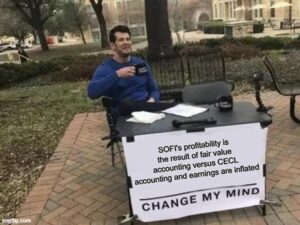
The concern is the borrower base. A large portion consists of the same white-collar professionals now exposed to wage pressure from AI. If that income stability weakens, the assumptions embedded in credit quality start to look aggressive.
Freddy’s base case is not subtle. If the accounting were reset and transparency improved, the stock would likely need to be at a much lower level to compensate. At current levels, he does not see that happening.
Right on the Fraud, Wrong on the Stock
Freddy also revisited a familiar problem in short selling. Being correct on the analysis does not guarantee a profitable outcome.
National Beverage Corp (FIZZ) is the example he highlighted. There were legitimate concerns around parts of the business, but LaCroix became a cultural phenomenon and overwhelmed the thesis.
A similar dynamic showed up with Celsius (CELH). On paper, it had several red flags, including links to the 1MDB scandal and very strong growth in a crowded category. Channel checks suggested the product was actually selling, which is usually what matters.
The broader takeaway is that markets are indifferent to moral arguments. Weak governance can persist as long as the numbers work. Investors generally ignore bad character until they are forced to deal with it, as in the case of John Kapoor and Insys, where apathy only ended once people started going to prison.
Project Shitadel and Copper
On the long side, Muddy Waters has been spending more time in resources under the Project Shitadel umbrella.
Freddy’s preference is copper rather than gold. The demand side is tied to electrification, data centers, and AI infrastructure. The supply side is constrained by long development timelines and persistent execution issues at the majors.
Companies like BHP and Rio Tinto tend to move slowly and often overrun budgets. That creates space for smaller operators. Freddy specifically pointed to the Lundin group (LUN CN) as one of the few teams that consistently advances projects.
The broader point is familiar. Large corporates rarely discover assets. They wait, then acquire them once the risk has been reduced, ideally near the bottom of the cycle.
Conclusion
Freddy is clearly leaning into both the AI angle and the next wave of dislocations, and he made it easy for anyone who thinks they can add value to reach out. If you are particularly sharp on using Anthropic’s Claude for research or idea generation, he is actively looking. He can be reached directly at **@****************al.com