
Specialty Chemicals Distribution (Part Deux)
Last week we dove deep into a sector that very few talk about. A young sector with just a few players and major growth tailwinds for years to come.
The sector seems to be inflecting upward after a 3-year bear market.
If you missed it, you need to check out last week’s publication.
Without reiterating everything we wrote, in short, this market is unique, with many attractive characteristics:
- It is still relatively small and driven by major secular tailwinds that provide a pathway for growth for years to come. End-market complexity is growing, increasing the need for specialty chemicals distributors.
- Given its small size and strong tailwinds, and the fundamental importance of specialty chemicals, the industry has been very resilient to economic downturns.
- Market fragmentation is huge, with just a few large players. As such, and given the growing complexity of the market, consolidation is necessary and has been a major driver of growth for the largest players. This will remain the case for years.
- Based on the above, specialty chemicals distributors could easily grow EBITDA by c.10% p.a. for the foreseeable future. Given their inherently asset-light business model, returns and cash flow generation are strong, and extreme market fragmentation gives them plenty of room to plow this cash back into the business.
- Only a handful of listed specialty chemicals distribution companies exist, and even fewer are pure players.
But beyond the sector’s interesting inherent characteristics, something else made us look.
Check out the performance over the past five years. Yuck.
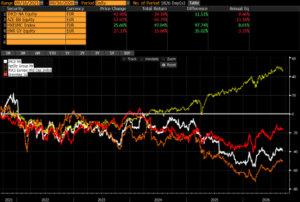
By the way, if you haven’t heard yet, when we talk about ‘the specialty chemicals distribution sector’, we mean IMCD (IMCD NA) and Azelis (AZE BB). That’s about it as global listed peers. There’s also Brenntag (BNR GY), but that’s not a pure play. More on this later.
Why the suffering
The market has experienced an unusual environment since COVID, creating a ton of uncertainty. These circumstances have made many forget (or ignore) the underlying structural trends reshaping the specialty chemicals distribution market in ways that favor nimble, well-capitalized players such as IMCD.
On top of that, many still have little clue what the sector is about. In our experience, most investors think: specialty chemicals distribution = specialty chemicals distribution = ‘hell no’.
This all has led to some remarkable market action.

The downturn in the specialty chemicals distribution market isn’t the result of a single factor, but of many pressures that have intensified over the past few years.
First, the horrible state of the overall chemicals sector has put significant pressure on volumes. This is a.o. automotive, construction, personal care, electronics… well, pretty much everything Industrial and a lot of life science as well.
Weak demand, overcapacity, FX headwinds, and large regional differences have been causing a lot of hurt. This is especially true in Europe, which has been basically killing the sector with idiotic sustainability policies and high energy prices.
For the uninitiated, just saying ‘chemicals’ is like saying ‘sports’; there are massive differences within the field. Ingredient companies like DSM-Firmenich or Givaudan aren’t even closely comparable to diversified basic chemicals players like BASF or Syensqo, and none of these are comparable to IMCD or Azelis.
But when the cycle is bad, everything with ‘chemical’ gets lumped together and punished. That is what happened, and IMCD and Azelis have been suffering as a result.
Such is life in everything chemicals-related (and part of the opportunity for those with the right stomach).
Compounding this is inventory destocking. After the supply chain disruptions of 2021–2022, many customers overstocked to basically hedge against the crazy demand volatility. While this led to a few golden years, the market then went through a normalization phase in 2023 and 2024 as inventories needed to return to normal levels.
Last week we mentioned that pricing within this industry is extremely opaque. IMCD and Azelis generally don’t have much pricing power, which can open up plenty of arbitrage opportunities in volatile environments. Gross margins expand in tough times, as ‘finder’s fees’ tend to rise. This is exacerbated if demand drops sharply for a period.
This is what happened during COVID; these companies had a few bad quarters and then a few insanely good years. At first, demand dropped. Then economies opened, and everyone needed product, with IMCD and Azelis happy to ‘abuse’ the situation.
And when we finally moved back to organic growth in late 2024, the yellow man threw a wrench in the engine. Geopolitical tensions and trade barriers further complicated things. Tariff uncertainty (especially between China, the US, and Europe) disrupted pricing and supply chains.
This has clouded visibility, with customers delaying deliveries and placing smaller, more frequent orders. Both IMCD and Azelis continue to highlight the shift in order patterns as a sign of persistent volatility.
And of course, the latest market panic: ‘new’ Chinese capacity entering the market.
We all know that if there’s one thing that scares the hell out of the chemicals market, it’s ‘China’.

Sure, Chinese competition has indeed been increasing (when has it not), but there’s a big difference between commodity chemicals, semi-specialty chems, and true specialty chems.
Chinese producers have been ramping up exports of semi-specialty chemicals, which is roughly ~20-30% of IMCD’s and Azelis’ product gamma. Taking the geographical spread and customer preferences into account, we’re talking about a relatively low impact on a small part of the portfolio.
But today the market doesn’t care what’s true or not – remember the lumping together of all companies. It still generalized this ‘threat,’ causing strong narrative shifts.
Could China produce much more specialty chemicals? Sure, but again remember: the long tail of ‘true’ specialty chemicals is massive, and they don’t travel. The volumes are simply too small and customized. This is ~70-80% of IMCD and Azelis.
Lastly, always keep in mind that we’re talking about specialty chemicals distribution. If you talk to the companies, they’ll tell you China is a big opportunity: many potential new customers, new regions opening up, and many potential new clients. Remember: volatility means good business for these guys.
Why the swing back could be vicious
As a result of the above combo, both Azelis and IMCD have reported relatively long stretches of weak performance in their industrial chemicals segments (the most cyclical of both sectors, Industrial and Life Sciences).
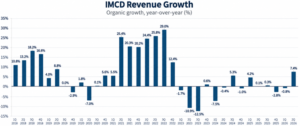
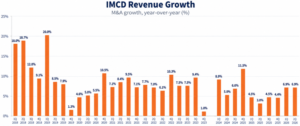
Check out IMCD’s sluggish organic growth after the post-COVID golden period.
But while the current environment remains tough, it also presents a unique window of opportunity.
Today, customer inventories are pretty much normalized, if not still low. Both IMCD and Azelis have regularly noted that destocking is largely behind them, and any uptick in demand should translate quickly into volume growth.
Both companies have been rightsizing their cost structures while continuing to invest in digital, sustainability, and innovation. Azelis is running a cost-saving program, while IMCD is maintaining its sales infrastructure to be ready for the rebound.
Also, given that the asset base is mostly working capital, cash flow generation tends to ramp in and time declines in good time – a nice countercyclicality which tends to come in handy when the cycle turns.
With valuations under pressure, it is now a favorable time to pursue strategic acquisitions. Both Azelis and IMCD are pacing their M&A at the moment, in part because Europeans don’t like leverage getting close to 3x, but they see strong pipelines and can act quickly.
Look at how much growth they bought in the past. If organic growth comes back, they’ll easily hit 10%+ revenue growth.
And on top of this, you can add:
- During volatile and economically uncertain times, clients tend to reformulate their products, looking for other and cheaper alternatives. This is prime business for IMCD and Azelis. Value-added services (technical support, regulatory expertise, and (re)formulation capabilities) are increasingly becoming essential. Distributors are not just logistics providers – they are innovation partners. This is especially important as customers seek to reformulate products in response to changing consumer preferences and regulatory pressures. Value-added services are almost pure gross margin ‘alpha’.
- COVID has driven a strong push toward digitalization. IMCD’s rollout of its Sales Assistant tool and MyIMCD platform are prime examples of the shift toward data-driven distribution. These tools enable faster product matching, better formulation support, and deeper customer engagement. In an industry where gross margin expansion is limited, this can have a big impact.
- The prices paid for bolt-on acquisitions are coming down, which is good if you’re a consolidator. Inorganic growth can accelerate rapidly as targets’ earnings are pressured as well.
- We always shiver when we need to write ‘ESG’, but the increasing investments into (more) sustainable products are undeniable, and an incredible tailwind. Distributors are pivoting toward bio-based, low-carbon, and circular products.
In short, bad times create (very) good times.
The two choices
The specialty chemicals distribution market is still facing cyclical headwinds, but the worst seems to be behind us. The structural drivers remain intact. For us, this has been a time to start leaning in. The market is fragmented, valuations are attractive, and the need for sophisticated distribution partners is only growing.
As said, the choices here are basically just two – IMCD and Azelis. Both are pure-play specialty chemical distributors. Then there’s Brenntag, but that’s a different beast.
Now this is important. Arguably the most important asset in this business is a company’s IT system. Think about it. This is a very heavy working capital business, with thousands of products and clients, lots of fragmentation, tiny volumes, and opaque pricing. Having one integrated IT system (CRM, ERP, warehouse management, etc.) across the entire company is a MAJOR deal.
And this is perhaps the biggest reason why IMCD is considered the best, Azelis a close second, and Brenntag kind of a loser in this respect.
Again, how do these companies grow? Among other things, with tons of acquisitions. And what happens when you don’t integrate fast enough and continue to acquire stuff? You get a company with 100 different platforms.
For example, Brenntag today. And that is exactly why a split between commodity and specialty chemicals distribution makes sense on paper but isn’t feasible in practice. No chance.
Anyways, forgetting about Brenntag, there are other differences between Azelis and IMCD:
- Azelis was listed not long ago and grew strongly inorganically in the years before. The market likes a track record, and IMCD has a pretty good one.
- Azelis recently had some company-specific issues (read: screw-ups) related to IT migration, and it also paid the price for entering 2025 with a way-too-aggressive cost base (FTEs), expecting to catch the returning organic growth (which Trump killed). IMCD has been more conservative, which paid off with less pain.
- Azelis is also still integrating some large acquisitions of the past. That will take time, and IT integration is a big part of it. Azelis is still running on a few big IT platforms; quite good compared to many peers, but is still some way off from IMCD, which is an integration machine. All of IMCD runs on the same IT stack – this is a HUGE competitive advantage in the industry.
- In contrast, Azelis is a tiny bit more tangible and asset-heavy. They, e.g., don’t mind doing a bit of local mixing and blending, at least until they’ve sold these assets, since this often results from acquisitions. This should, in theory, generate slightly higher margins in good times and slightly worse in bad times. We would ignore it, though, when comparing the two.
- Lastly, until recently, EQT still held a large stake in Azelis. People don’t like PE overhang, which was a reason for a discount.
These are the main reasons why Azelis is trading at roughly 9.5x forward EV/EBITDA and IMCD at 11.8x.
So the choice is Azelis, a clear IMCD-wannabe with arguably more upside as the company matures, or IMCD, the highest quality company in the sector with a long track record of success.
In our case, we just went for the small basket. Both stocks provide strong upside and long compounding potential. No reason to be nitpicky here.