The Specialty Chemicals Distribution Industry
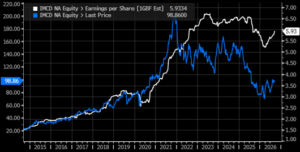
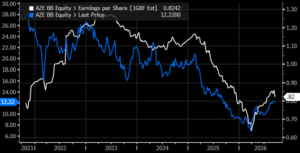
Specialty chemical distributors are a niche sector that gets little coverage in the real world. However, for KEDM subs, we hope companies like Azelis (AZE BB) and IMCD (IMCD NA) are already on your radar, because we have tried to cover their every move over the last few years.
We have always promised an industry deep-dive, and over the next two weeks we will deliver on this promise.

Specialty chemicals distribution is one of our favorite industries for reasons described below, and we think the time has finally come for this sector to shine.
We’re now six months into a Strait of Hormuz closure, and many products are beginning to run short.
We recently covered the base-oil shortage in our piece on refiners, with Calumet (CLMT) as our preferred way to play. But as we dug deeper into those shortages, we started to see pending shortages across the entire petrochemicals space.
Imagine you’re in the business of selling fancy shampoo that your girlfriend pays $100 per bottle for. You wouldn’t want to run out of the essential chemical that gives the shampoo its smell, texture, or performance. Apparently, whatever makes shampoo smell like a Tuscan sunset matters to the beauty industry’s economics.
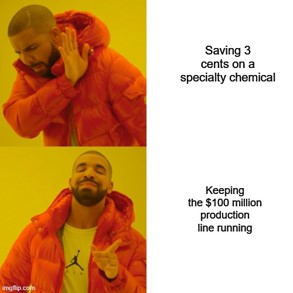
And if you are about to run out of this key ingredient, you start stocking up. Given that the total cost of this essential chemical is often negligible, you are willing to pay whatever price is necessary to keep producing your fancy shampoo. Nobody gets promoted for saving three cents on an ingredient that shuts down a $100 million production line.
That creates the perfect setup for distributors. They’re the guys you call when you want to get your product at whatever-the-cost. Distributors shine in periods of inflation. To top it off, China has long been flooding the industry with cheap exports, but high energy costs and anti-involution are causing those exported volumes to drop. After a three-year bear market, the industry is showing its first signs of inflecting.
Are the stars finally aligned for specialty chemicals distribution?
This is going to be a long one (you asked for it), so we’re splitting it in two. This week we’ll lay out why we think this is such a cool industry, and next time we’ll dive more into the two names that we’ve been buying.
Here is this week’s TLDR:
- The specialty chemicals distribution market is still relatively small and driven by big secular tailwinds, which provide a pathway for growth for many years to come. End-market complexity is growing, increasing the need for specialty chemicals distributors.
- Given the industry’s small size and strong tailwinds, combined with the fundamental importance of specialty chemicals, the industry has been very resilient to economic downturns.
- Market fragmentation is huge, with just a few large players. As such, and given the market’s growing complexity, consolidation is necessary and has been a major driver of growth for the largest players. This will remain the case.
- Based on the above, specialty chemicals distributors could easily grow EBITDA by over 10% p.a. for the foreseeable future with strong resiliency. Given their inherently asset-light business model, returns and cash flow generation are strong. Market fragmentation gives them plenty of room to plow this cash back into the business.
- Only a handful of listed specialty chemicals distribution companies exist, and even fewer are pure players. Interestingly, these distributors will often beat consensus estimates.
In short, this is a young and resilient industry that grows organically at GDP+, with a handful of listed market participants growing even faster given the possibility of ‘plug-and-play’ M&A, and the potential to keep doing so for a long time.
What the heck are specialty chemicals
Specialty chemicals and ingredients are chemical products that provide a wide variety of specific, targeted effects (we’ll skip the ‘ingredients’ part from now on for the sake of efficiency and sanity). These chemicals are a fundamental part of the end product, giving it specific characteristics. Without them, the end product wouldn’t have important qualities, such as targeted (enhanced) performance, a specific color, taste, or nutritional attribute.
Specialty chemicals, also known as performance chemicals, are used as key ingredients in finished products. Their composition strongly influences product performance and processing. They are generally applied in customer-specific formulations and are fundamental key inputs; they cannot be easily replaced, except perhaps with other specialty chemicals.
Examples of end-products where specialty chemicals are important inputs include shampoos (with endless types often differentiated by specific specialty chemicals), drugs (active pharmaceutical ingredients), dishwashing powders (biocides), construction chemicals (additives), and even gummy bears (maintain sweetness while reducing sugar).
One important thing to keep in mind. The term ‘specialty’ in the chemical world is likely the most abused term ever. Almost every chemical producer will tell you that a big part of their volumes is ‘special’ and, as such, is worthy of higher value. That’s often a blatant lie, or at best a half-truth.
What we’re talking about here are real specialty chemicals – that long tail of less-known chemicals; very small volumes, no price transparency, very important to the final product.

What do specialty chemicals distributors do
As just explained, specialty chemicals are a fundamental part of the end-product but just a very small part of the total product. The volumes of specialty chemicals needed to make the product functional are generally tiny. To give you an idea, an average customer makes fewer than ten orders per year, with an average order size of no more than $10-15k.
There are many differences between commodity chemicals and specialty chemicals. Perhaps the most important distinctions are that commodity chemicals tend to be sold in large volumes, and their pricing is transparent and supply- and demand-driven. Specialty chemicals, on the other hand, are typically sold in small quantities, and pricing is far from transparent; there are no ‘price lists.’ This creates lots of opportunity for enhanced margins.
That is also the case because specialty chemicals generally don’t travel long distances. Order volumes are too small, and logistics can quickly become a major part of total production cost.
Another key aspect of specialty chemicals end-markets is that they are becoming increasingly complex as they mature. Think about the myriads of shampoos, skin care products, medicines, (healthy) foods, performance and construction materials, etc. we see today, and compare them with a few decades ago. This increasing complexity is a global trend. Products need to become better, more customized, more efficient, cheaper, healthier, safer for the environment, etc.
The combination of small volumes and growing complex end-markets is making it increasingly costly for producers to reach manufacturers, that is, the end-clients who buy the specialty chemicals to produce the end-product. Specialty chemical producers are generally larger, traditional chemical producers such as dsm-firmenich, Symrise, BASF, IFF, and Givaudan. As a general rule of thumb for these large chemical suppliers, ~20% of customers contribute ~80% of revenue.
Remember that these are not your standard chemicals; the salesforce requires much more technical expertise, often needed to explain the product’s specifics and alternatives to the client. Imagine the cost of maintaining many small dedicated sales, marketing, and distribution arms. Therefore, large suppliers have been increasingly happy to outsource the distribution of smaller specialty chemicals.
Distributing many small batches = a headache.
In addition to providing customers with the necessary technical expertise and services (e.g., warehousing, packaging, labeling, regulatory compliance), specialty chemicals distributors bundle many products and offer formulation advice; they work with clients to develop new, customized formulations. That’s why the larger specialty chemicals distributors have many ‘innovation labs’, creating a strong value-add for customers (and a bit higher margins for themselves).
In short, specialty chemicals distributors are a platform, linking many large suppliers (often hundreds or even >1,000) to many more small manufacturers that generally target specific regions and products. They provide a much-needed, cheaper service to large suppliers and make life much easier for manufacturers.
A small market, with plenty of tailwinds
A big driver of growth will continue to be producers outsourcing sales, marketing, and distribution to pure-play distributors. The outsourcing rate is estimated to be in the high teens % and growing on average ~0.5% per year, which translates to about $2-4bn extra revenue per year to be divided amongst specialty chemicals distributors. For comparison, the largest pure-play specialty chemicals distributor (IMCD) generates about $6bn in revenue. This is on a total market size of $200-300bn (Azelis, IMCD rough estimates).
And the pace of outsourcing has been increasing; as distributors grow, so do their network, reach, and knowledge, which makes them more attractive to producers. Growing distributor network = more business. For example, big players like Givaudan currently work with 40+ distributors in Northern EuropeNorthern Europe alone, and they’ll gladly tell you that, in an ideal world, that number would be 5-8 globally.

Besides outsourcing and increasing complexity of end-markets, other factors will continue to drive distributors’ growth:
- As end-markets and geographies mature, customer needs become more differentiated, increasing demand for (more) customized solutions, and thus specialty chemicals.
- Increasing complexity also increases regulation and the need for suppliers to focus on efficiency (hence more outsourcing).
- The above also leads to increasing investments in product and formulation expertise – an area of expertise of specialty chemicals distributors.
- Importantly, end-markets are incredibly fragmented. A BIG part of growth comes through acquisitions, where larger players buy smaller, local players to target a specific geography, product, and/or supplier relationship. As they grow, larger suppliers become more dependent on distributors.
Because of all the above, specialty chemicals distributors have strong, resilient financials and can grow earnings in the low- to mid-teens % range for at least a decade on average; this brings us to the ‘through-the-cycle growth formula’.
As a back-of-the-envelope calculation: GDP+ industry growth (3-5%) + acquisitions (4-6%) + outsourcing (0.5-1%) + operating leverage (10-20bps p.a.) = roughly 10%+ EBITDA growth p.a., for a looong time.
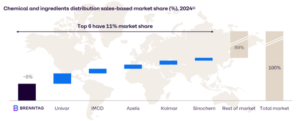
Source: Brenntag. Market share estimates vary by source, but the chart provides a good indication of the extreme fragmentation of the industry.
Gross margins and the conversion rate are key.
Always keep this in mind: specialty chemicals distributors do not produce anything themselves. They buy the goods from the big suppliers and distribute them. They don’t even change labels; an acquired Symrise chemical is sold with the same brand.
The pricing mechanism is simple. A distributor of specialty chemicals, such as IMCD, regularly receives price lists from specialty chemical producers. IMCD takes that price; there’s (generally) no bargaining or volume discount whatsoever. IMCD then passes these prices on to clients, adding whatever margin it can get. That margin depends on product availability and demand, COGS (logistics, warehousing, etc.), and other value-added services such as formulation advice.
Bottom line, gross profit (margin) is of great importance in the specialty chemicals distribution industry, rather than overall revenues. Another key metric is the conversion ratio (EBITA / gross profit), which indicates the efficiency of the business.
Given the vast number of acquisitions, amortization of intangibles is sizeable. As such, specialty chemicals distributors generally use EBITA as a proxy for operating profit.
Be careful when looking at the returns these companies report, which are generally returns on tangible assets. These are often extremely high, as in >40%. While this is technically correct, keep a few things in mind. Remember, specialty chemicals distributors acquire a LOT.
- Distributors acquire other smaller distributors. What do they buy? Well, as mentioned, it’s mostly supplier relationships, access to local market and/or salespeople, and perhaps specific formulations or know-how. This is often subsumed in goodwill, accounting-wise.
- Also, as you probably noticed, these assets are all intangibles. When a company acquires another company, accounting standards require a purchase price allocation to be performed. In a PPA, the purchase price is allocated to all the acquired assets. Fixed assets and working capital are generally taken as-is, and intangibles are valued with some prescribed valuation methodology. The rest is assumed to be goodwill.
- While supplier (and client) relationships are separately valued and recognized on the balance sheet, intangibles such as networks and know-how are subsumed directly into goodwill.
So, while distributors have asset-light models and their return on tangible assets is sky-high, keep the above in mind. The ‘true’ returns on capital lie somewhere in between ROCE incl. intangibles (incl. goodwill) and ROCE excl. intangibles.
There’s less than a handful of listed distributors of specialty chemicals
A major thing that makes this industry so interesting is that while many listed companies globally are active in chemical distribution, only a handful focus solely on distribution (rather than, e.g., production and trading as well). And even fewer are pure-play distributors of specialty chemicals.
In short, there’s IMCD (IMCD NA) and Azelis (AZE BB). Both are dedicated distributors of specialty chemicals and considered to be the best in the sector. Brenntag (BNR GY) is partly similar, a so-called full-liner, distributing both commodity and specialty chemicals.
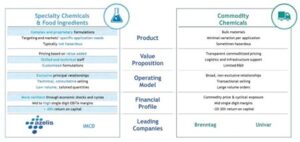
Source: Azelis prospectus.
Don’t assume there isn’t a big difference between commodity and specialty chemicals distribution. There absolutely is, and the impact on the financials is material. Given the vastly lower volumes and price transparency, and the importance of the material to the final product and overall formulation needs/advice, IMCD and Azelis’ businesses are much more profitable, resilient, and generate higher returns.


M&A to the core
Growth from acquisition is in the DNA of specialty chemicals distributors. Integration is very easy, and dyssynergies are generally non-existent.
Remember what we just discussed about the assets these distributors target: supplier and client relationships, network, salespeople, and know-how. All these acquired assets can easily be added to an existing network, and (larger) chemical distributors have done it hundreds of times throughout their history and will continue to do so given the vast market fragmentation.
With respect to acquisition multiples. There are two types of acquisitions: larger but infrequent ‘platform’ acquisitions, which build a new base in a certain region, and regular bolt-on acquisitions. Platform acquisitions tend to go for low double-digit EV/EBITDA multiples, while bolt-ons are at mid to high-single-digit EV/EBITDA. The multiples themselves don’t change much through the cycle – the main discussion is generally on the base earnings on which to peg the multiple.
An interesting corollary here is that sell-side analysts exclude inorganic growth in their models. The reason is obvious: the exact impact on the financials is hard to estimate; how much is paid and acquired, the timing, the recognition of the intangibles on the balance sheet, general laziness, etc. Bottom line, most analysts don’t do it.
That’s fine for most industries where acquisitions are infrequent, but it is quite wrong for specialty chemicals distributors if you don’t include estimates of inorganic growth. As mentioned, M&A is an integral part of the business model, so you have to account for it.
The bottom line here is that one cannot look at specialty chemicals distributors and not take growth from acquisitions into account. Just assuming organic growth and excluding inorganic growth will lead you to underestimate growth, big time.
And keep in mind that this ‘error’ compounds; estimates a few years out might be off by as much as 20%, assuming average historical inorganic growth.
More to come
But that’s enough for this week. We still have plenty to discuss, but we imagine our readers have a migraine by now.
Next week we’ll dive into the issues the sector has faced over the past few years, and we’ll go a bit deeper into IMCD and Azelis.