
This Monday, Google surprised the market by announcing the mother of all secondaries. Google plans to raise $80 billion, consisting of a $15b convertible and $25b of common stock, followed by a $40b ATM in Q3.
The official reason is to fund AI Capex and pay taxes on employee stock compensation. The timing seems obvious … they want to get ahead of the liquidity crunch that is bound to happen when SpaceX, OpenAI, and Anthropic hit the market with new supply all at the same time.
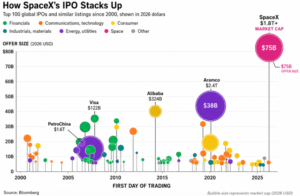
We recently wrote about how the typical IPO underperforms by ~20% on a 3-year horizon. This effect was more pronounced when companies were unprofitable, resulting in an average underperformance of 30%.
But companies like SPCX are not set up for patient buy-and-hold investors. Index providers waived the profitability requirement and cut the seasoning window from 90 days to 5. Passive investors will be forced to buy shares just after the initial IPO pump, and just before the accelerated unlock. There’s a 200-year history of finance bros dumping on retail. SpaceX simply figured out how to do it at scale.
$80 billion here and $70 billion there, and soon you are talking real money. And while ChatGPT and OpenAI are racing each other to not be the last one to IPO, Google simply moved to the front of the line, just in case the music ever stops playing.

Since we can’t all buy into the SPCX IPO with the intention of selling it to passives just before the tsunami of insider selling, there must be some sort of long-term thesis. We’d think that even retail investors would look through promises of data centers in space and a Kardashev Type II civilization. And even though the retail investor of today might be slightly more gullible, there has to be some limit to the amount of capital chasing those names.
Will TSLA investors be spread thin over multiple Musk ventures? Or will the crypto bros abandon ship and jump onto something a negligibly more exciting?

But rather than speculate on where the liquidity will come from, looking at the past 6 months, it seems the AI trade has already been sucking liquidity out of the rest of the market. The wave of mega IPOs and secondaries promises to do the same, just at a larger scale.
Quality investors have had a rough last 6 months holding on to the various compounder stocks, often at inflated multiples. With AI stocks going up 15% a day, who is really interested in holding on to companies that promise to do 15% per year?
At least there is a narrative for why MSFT traded down to 20x P/E on increased Capex, or why people think a company like BKNG is about to get disrupted and deserves to trade at 14x P/E despite 15% targeted EPS growth and a strong track record of backing it up.
We also understand why the market turned sour on most companies with excessive SBC.
But it’s becoming clear that defensive businesses are being sold down in unison just because they feel… boring!?
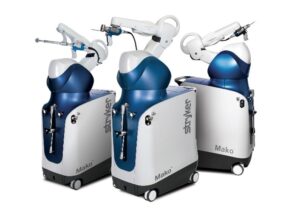
Take Stryker (SYK) for example. We wouldn’t often talk about a boring compounder that trades at 20x P/E. But with consistent 8-9% revenue growth, some operating and financial leverage, and a 5% earnings yield, your expected IRR is well above 15%. In the world of compounder bros, that’s undervalued.
Iranian hackers brought SYK’s manufacturing operations to a halt in late March, leading to a rare earnings miss. But manufacturing has been restored, and management remains confident that they can catch up with most of the lost sales later this year. We are highlighting Stryker as a play on our elderly care theme.
For those less familiar, SYK provides medical equipment including orthopedic implants and hospital beds. They have shown four decades of well-above-industry growth with no signs of that outperformance disappearing. Companies that have been 400-baggers have traded at premiums.
Or how about a regulated utility? PG&E (PCG) was one of our bankruptcy emergence plays in July 2020. Regulated utilities are about as boring as it gets in the equity market, because they can reinvest their cash at ROEs of ~10% while borrowing against those assets to pay dividends. Some earn 9.5% ROEs, while others earn 10.5%, but that’s all the excitement you’re going to get.
But PCG and Edison International (EIX) add significant wildfire-related tail risk. The 2018 Camp Fire caused both companies to file for bankruptcy, and the more recent Eaton Fire depleted the wildfire fund, exposing both companies to the risk of unfunded, off-balance-sheet liabilities.
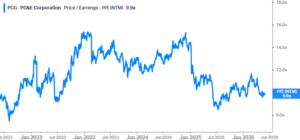
This means that PCG now trades at the bottom of its usual 10-15x P/E range… right at the time where change might be incoming.
The key potential regulatory catalyst is a follow-on to California’s 2024 wildfire legislation, Senate Bill 254 (SB 254). SB 254 directed the California Earthquake Authority to study permanent solutions to utility wildfire liability, and the resulting proposals include granting utilities a safe harbor if they comply with approved wildfire mitigation plans, capping damages, socializing wildfire costs, or even creating a state-backed wildfire insurance system. Any legislation implementing these recommendations would further reduce PG&E’s wildfire liability risk and could lead investors to value the company more in line with other regulated utilities.
Figuring out the direction of policy in California is above our pay grade. But we note there is clear option value in PCG, which the market at 10x P/E doesn’t price. We are adding PCG to our Fallen Angel monitor.
But there are many more. CME, ICE, and CBOE sold off this week due to the launch of perpetual futures and now trade at 20x P/E ratios. SPGI might have some data products that are less valuable in an AI-driven world, but their ratings enjoy a regulatory moat that even the GFC couldn’t break: 20x P/E. And don’t get us started on payments companies (RELY, WSE, ADYEN NA).
This feels like the market to buy some quality compounders and chill, while the market debates which company with complicated tech is the next AI bottleneck.
Over the next few weeks, we plan to clean up our inflection monitor and provide updates on the still-relevant themes. Some themes worked well, and some have clearly become stale. We are becoming increasingly confident adding some neglected names to our fallen angel monitor (did you guys see Tencent rip!?).
There are many ways to earn your return without having to play the game of musical chairs. The upcoming mega IPOs might mean the music stops playing, and we’re happy holding on to some defensive-quality names in case that happens.