
Discipline!
Before we get started, what a difference a couple of weeks can make…
Last week, we did a deep dive into Japanese activism and introduced our dedicated Japan monitor. We also mentioned 2 ways to play the improvement in Japanese corporate governance that were easy enough for a gaijin to wrap your head around: Integral KK and Hikari Tsushin. Check it out if you haven’t already.
We also wrote about the catch-up potential of Emerging Markets as inflation and rate-hike fears ease. Specifically, we revisited our Macau Casino theme, noting that their stocks had sold off on the back of a soft June. The world was busy watching the World Cup, and Macau visitor rates suffered.
2 weeks later, the World Cup has ended, and Macau Casinos are rebounding. Will the rebound last? Who knows. But casino stocks are up about 15% amid improving visitor rates. The valuation of mature companies isn’t supposed to fluctuate by 15% based on what’s on television. We’re kicking ourselves for playing this too small. We never believed market moves would be this predictable.

Investing is supposed to be hard. We’ve been humbled by the market more often than we can remember. But today’s trades seem more obvious than usual.
The highest quality companies are for sale because why would anybody care about a stable 15% growth per year if AI companies can go up 15% in a day?
As value investors, we tend to be drawn to mediocre business models with shitty management teams and a risky turnaround plan.
It makes us feel smart if we predict a successful turnaround and buy into it just before the market catches up with what is happening.
But in this market, being a quarter too early means you will lose 30% on a minor earnings release. Being a few quarters early, and your stock will go down enough to ruin your quarter.
So why not take advantage of the selloff in quality? If quality companies are for sale, why put up with an undercapitalized small-cap with a CEO who never delivers on his promises? Some companies have been compounding at double-digit rates for decades. They are founder-led. They dominate their industry. And if you put some effort into picking the right ones, you can underwrite IRRs well north of 20% without requiring any rerating.
The Compounder Bros have been over them for the last 10 years, but more recently their fortunes have turned. Their performance has lagged. They are no longer the hottest fund in their firm. Their CIO no longer asks the compounded bros for a market overview during the weekly all-hands meeting. Instead, tech investors are now being asked for their opinions, and the quality guys are suddenly seated in the back next to the credit guys.
Many of our friends who used to fall firmly in the quality bucket have recently rebranded as bottleneck investors. They’re telling us that memory is no longer cyclical, and even if it is, “we’ll always need more chips.”
Nothing could better mark this transition than Fundsmith selling its quality companies to join the MoMo crowd.
So our goal for the year is to be the most disciplined investor. Trying to be too smart is a risky business. Instead, we’ll only get involved in trades that feel obvious. And there are plenty of those.

What does that mean for our positioning? We have been adding names to our compounder theme recently and will continue to do so over the next few weeks. We’ve made no secret of our holdings in Stryker, Adyen or Tencent. These are all names that in any other year would have been considered too boring to even talk about in a newsletter.
Of course there is our thematic book. We introduced many new themes over the last year, and we are in the process of updating you on all of them. But it goes without saying that our long vol basket, trade schools, refiners, aerospace aftermarket, and payment companies are among our more popular themes.
The Return of ED
But the biggest change is that we have also been making significant additions to our event-driven book.

Take spinoffs as an example. For the last five years, corporate America seemed to have been taking advantage of the market’s willingness to take Spincos off their hands. They would take the business that most resembled a melting ice cube, stuff it with some legacy liabilities, and let the SpinCo pay a major dividend to Remainco. Spincos were set up for failure.
Just to name a few: Organon, Embecta, Vestis, and Loyalty Ventures were so indebted that they never stood a chance, given the need to reinvest in their business.
But the businesses that have been hitting the market more recently are sort of ok. We recently wrote up Spincos and shared our opinions on MBGL, HONA, OCTV, and MFP.
None of them are “guaranteed multibaggers with no downside” (that’s what we tell our investors we are usually after).
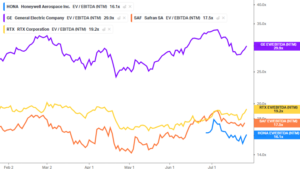
But Honeywell Aerospace (HONA) at ~22x P/E seems interesting. You know our opinion on aerospace and defense. HONA serves both. They are guiding for HSD growth over the next few years, but they’ve been growing at double-digit rates given the strong industry tailwinds. Admittedly, the last 2 quarters have fallen short, but as a stand-alone company with a little more focus, we see no reason they would underperform their peers, who are all growing in the double digits at the moment.
Especially their #1 position (65% market share) in Auxiliary Power Units is a high-quality business with lots of future after-market revenues.
Then there is Mobility Global (MBGL), which was separated from S&P Global because of limited strategic fit with the rest of the organization. It’s a data business best known for its Carfax brand, which maintains reports on all cars currently in circulation. Invaluable information if you want to know the history of a used car before a sale, but also a brand that provides legitimacy to any car dealer that partners with them.
Meanwhile they have other B2B solutions that help OEMs with the pricing and positioning of new cars (e.g., if you drop the horsepower of your engine, how would that impact sales), or help dealers with targeted advertisement (e.g., whose car has just gone off lease or who’s got positive equity on their car and who might be in the market for a new car?).
Of course, the fear is that anything that’s data will be easier to copy in an AI-dominated world. In reality, if data is proprietary – like data that is shared with MBGL through their partnership with second-hand dealers or repair shops – the data becomes more valuable because AI helps turn the data into solutions.
Management believes MBGL is a 7-10% growth asset with margin expansion on top. Such an asset should not trade for 13x 2027 FCF, not even if management gets a little greedy by boosting SBC, which adds 1% dilution per year.
As we said, neither MBGL nor HONA is a near-term multi-bagger. But we do think they will rerate higher over the next few quarters as forced selling abates, sell-side analysts initiate coverage, and more buy-side analysts familiarize themselves with the business. We carry them at ED weight.

But even bankruptcy emergence is making a comeback. This monitor has been by far the most alpha-rich. Why do post-bankruptcy companies perform so well? The reasons are multifold.
Companies generally emerge from Chapter 11 with a cleaner balance sheet. The first weeks or months of trading can see selling pressure, as not all creditors who have received equity can hold their newly received shares within their mandate. Also, during the bankruptcy process, the company often downplays its earnings potential to improve its bargaining position with creditors. Some legacy liabilities, such as expensive leases, might be canceled. Finally, many industries are cyclical, and by the time a company emerges from a prolonged bankruptcy process, the cycle might already be turning.
This brings us to Office Properties Income Trust (OPI), an externally managed REIT of Class B/C office properties, where mismanagement and self-dealing by the external manager, RMR, are widely considered to have played a crucial role in the company’s demise. RMR’s continued involvement is often cited as a good reason not to get involved. We are not here to disagree, but we would like to point out the following.
First of all, OPI trades at roughly a 10% cap rate, which seems fair for an overleveraged office portfolio. But it ignores almost 30 properties that are operating at break-even or are loss-making. We expect the company to announce a disposal program, in which case non-accretive assets might suddenly be worth something. We won’t argue that break-even assets should sell for a lot; at least 2 assets (20 Mass Ave in DC and 2 buildings on Elliott Ave in Seattle) are vacant because of recent modernization.
The other point is that the management agreement with RMR clearly puts the ex-creditors in charge. Except for their seats on the BoD, the management agreement pays RMR only a fixed $14m per year, and it can be terminated at no cost after 2 years (or immediately upon payment of the remaining management fee for the 2-year term).
Have office values bottomed? We don’t know. It wouldn’t be hard to find data showing offices are stabilizing, but at the same time, we feel like that’s nothing a little bit of AI overinvestment can’t change.
In conclusion, we’ve had a good first half of 2026, and we intend to take advantage of some of the mispricing we are seeing in quality companies. We continue to be invested in our core themes and have recently begun meaningfully adding to our ED basket.
Remember, ED positions are not intended to all be home runs. The point of ED is to hit a lot of singles. And we believe many of those opportunities are emerging, which we will continue to flag in our monitors.