
Back in March, when the Strait of Hormuz closed, we wrote about the difficulty in negotiating with a fragmented Iranian regime. Who do you make a deal with if you just eliminated everyone in charge? We predicted a long and complicated path to an eventual reopening.
4 months in, we are not surprised to see that a country known for frequently chanting “Death to America” and the United States of America cannot come to terms.
We seem to be further away from a solution than ever. But maybe it’s time to imagine a scenario where Trump simply declares victory, washes his hands of the situation, and hopes for the best. Iran might charge transit fees for passage through the Strait of Hormuz, and occasionally sink a vessel if anyone forgets to pay their dues, but this is nothing the Ministry of Truth can’t handle. We are not predicting this will happen imminently, but at least it is time to think about what the world will look like post the Iran conflict.

To everybody’s surprise, oil prices are close to where they were before the start of the Iran war. An anticipated decline in demand, predominantly from China and the rest of Asia, has subdued prices. Meanwhile, supply increases from the UAE, the US, Brazil, and potentially even Iran will keep the market well supplied once the SoH fully reopens.
Fortunately, our exposure in the energy industry is through refiners, as well as through the commodity brokers (sorry, we just had to mention Marex) who benefit from an increase in traded volumes – regardless of price.
Our refineries are on fire. Quite literally. Not only is there a product shortage that will take years to replace, but Ukraine is getting more adept at taking out Russian refineries. And every time a US refinery burns down, that’s more supply being taken off the market.
The markets feel eerily similar to 2020. Back then, when it became clear that we were not all going to die imminently from germs, markets rallied well before the world had gotten back to normal. We were all still on Zoom and wearing masks at the grocery store when the S&P 500 hit new highs.
However, for value investors, this period felt horrible. Stocks made new highs, while they didn’t get to participate. Nobody was investing their fresh stimmies in cash-flowing companies with strong fundamental growth.
Instead, people were either investing in Elon Musk-backed ventures and renewable energy companies that all benefited from government handouts, or in stay-at-home stocks like Peloton and Zoom – companies that would see a real pickup in earnings. However, everyone could foresee a certain cyclicality in those earnings.
It wasn’t until later that year, after the chatter around vaccines started, that value investors got to join in the fun.
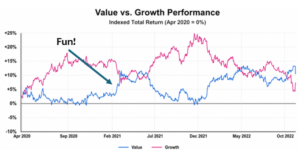
Source: factorstoday.com
And those stocks had a lot of ground to make up for, given where they started from. While some people spent 2021 chasing EV companies and SPACs (we did some of that too), the easy money was made by finding out what had worked in the US as a recovery trade and then buying the same industry abroad.
Where does that leave us today? The US has massively outperformed, and most of that performance is attributable to the AI / semis trade. We can’t argue with the impressive growth this sector has seen, but we do know that many of those business models are cyclical and high prices either call for demand destruction or for supply to catch up.
Are we seeing a supply catch up? Reports that Apple has begun testing DRAM chips from China’s state-backed ChangXin Memory Technologies (CXMT) suggest that supply will find its way to market, one way or another.
Meanwhile, US quality compounders, or international stocks, have been left for dead. In our piece on the coming liquidity drain, we talked about our interest in quality compounders. Today, we’re adding Copart (CPRT) to our compounder basket (see thesis below under CEO changes).
Then there are Emerging Markets, which have been a bad place to invest since the start of the year. We get it; inflation and rate hike expectations have weighed on the sector. But maybe this week’s CPI showed that we have reached peak rate-hike expectations? Does EM become the catch-up trade for H2?
Let’s talk about China. Except for several hot Chinese AI companies, stock market performance this year has been a disaster.
Our thesis was twofold. We were bullish on the revival of Hong Kong as China’s offshore financial hub. We were also bullish on Chinese equities because a stable and strong equity market was clearly government policy.
Let’s start with Hong Kong’s economic revival. While the number of expats outside Joe Banana might have declined in recent years, they have been replaced by Mainlanders who are setting up offices in Hong Kong.
We expressed this view through the Hong Kong Exchange (388 HK) as well as through Hong Kong property plays such as Hysan (14 HK) and Wharf REIC (1997 HK).
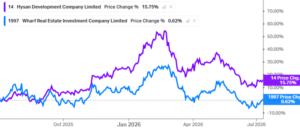
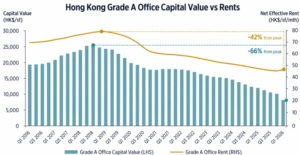
Prime office fundamentals in Hong Kong continue to improve. Vacancy has fallen to its lowest level in seven months, with strengthening demand in Central beginning to spill over into neighboring business districts. We think we nailed the turnaround. But our HK property stocks have given back most of their gains from late last year. Rather than complain, we see this as an opportunity.
Our play on China was more complicated and was limited to Chinese tech and Macau Casinos.
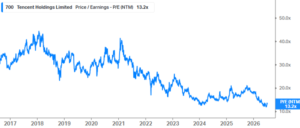
We recently added Tencent (700 HK) to our fallen angels monitor. Similar to Microsoft, Tencent seems to have fallen out of favor because it doesn’t have the latest and coolest AI model. But when we look at the company, we see a company with distribution to 1.4 billion people in China and abroad, which can be monetized in various ways. Our visit last year to their Tencent office showed a long list of tech initiatives, from flight simulators to robotics. We think the company has decades of improved monetization ahead of it.
It is rare to see a dominant tech company trade at 12x FCF, or closer to 9x FCF when crediting the company for its various investments.
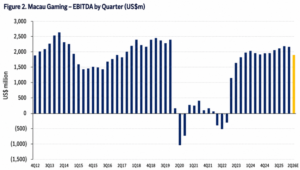
Finally, on casinos, we are actually content with the recovery in Macau gaming revenues. Margins might have disappointed somewhat (Sands China spent too much money on organizing an NBA event in Q4), and MGM China screwed over minority shareholders by increasing the royalty payment to their US-listed parent, but overall growth has been steady.
So why are shares down? Ironically, Q2 will come in soft because the World Cup competed for visitors to Macau. Does that impair the fundamental value of those casinos? Of course not. Is it a reason for the market to sell off Macau casinos in favor of hot AI stocks? Apparently so.
Source: DICJ
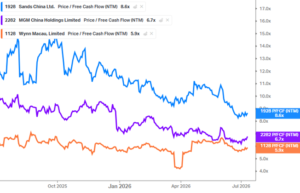
Sands China (1928 HK) now trades at roughly 9x 2026 FCF, with mid-single-digit growth and no way to spend all that FCF other than to increase its dividend. The other casino operators are cheaper. We are buyers.
In short, with the US market making new highs while emerging markets remain in the doldrums amid higher inflation expectations and the potential for rate hikes, we think the opportunity lies in finding the next catch-up trade. Emerging market equities fit that bill.
Emerging markets sold off amid inflation expectations and fears of rate hikes. Those fears seem to have peaked.